
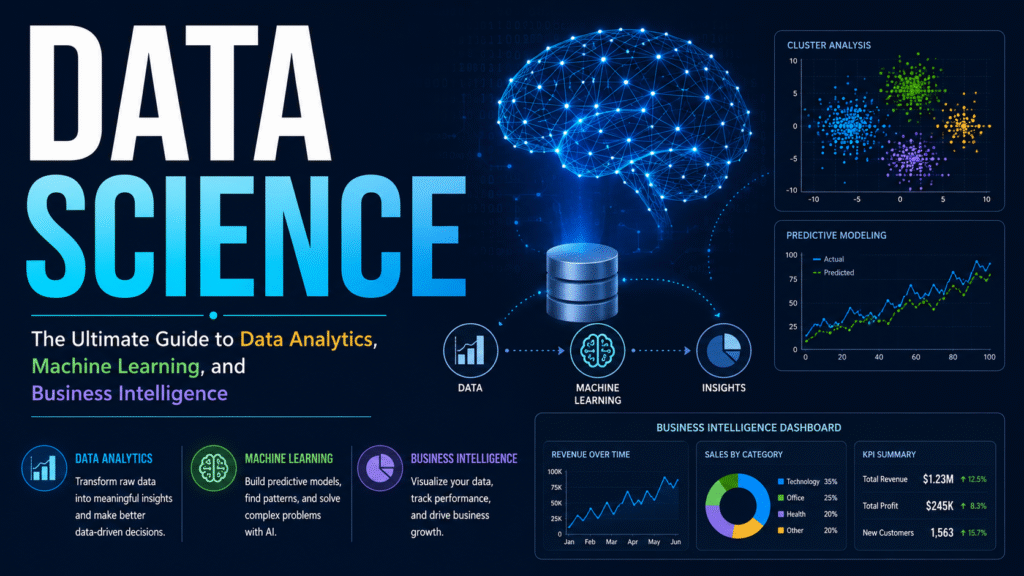
Data Science: The Ultimate Guide to Data Analytics, Machine Learning, and Business Intelligence
Introduction to Data Science
In today’s digital economy, data has become one of the most valuable assets for organizations worldwide. Every online activity, business transaction, social media interaction, and customer engagement generates information that can be analyzed to uncover meaningful insights. The discipline responsible for transforming raw information into actionable knowledge is known as Data Science.
Data Science combines mathematics, statistics, computer programming, domain expertise, and advanced technologies to analyze and interpret complex datasets. Organizations across industries use Data Science to improve decision-making, predict future trends, optimize operations, and gain competitive advantages.
The rapid growth of Big Data, Artificial Intelligence, and Machine Learning has accelerated the importance of Data Science in modern business environments. Today, companies rely heavily on Data Analytics, Data Analysis, and Business Intelligence systems to understand customer behavior, improve efficiency, and drive innovation.
As digital transformation continues to reshape industries, professionals skilled in Data Science, Data Mining, Data Visualization, and predictive analytics are becoming increasingly valuable.
What is Data Science?
Data Science is an interdisciplinary field that uses scientific methods, algorithms, processes, and systems to extract knowledge and insights from structured and unstructured data.
At its core, Data Science seeks to answer important questions such as:
- What happened?
- Why did it happen?
- What is likely to happen next?
- What actions should be taken?
By combining Data Analysis, statistical modeling, programming, and machine learning techniques, data scientists can identify patterns and trends hidden within large datasets.
Unlike traditional reporting methods, Data Science focuses on predictive and prescriptive insights that support strategic decision-making.
Why Data Science Matters
Modern organizations generate massive volumes of information daily.
This data comes from:
- Websites
- Mobile applications
- Social media
- Sensors
- Customer transactions
- Enterprise systems
Without proper analysis, this information remains unused.
Data Science helps organizations:
Improve Decision Making
Data-driven decisions are often more accurate than decisions based solely on intuition.
Understand Customers
Businesses gain deeper insights into customer preferences and behaviors.
Increase Efficiency
Organizations can identify inefficiencies and optimize processes.
Reduce Risks
Predictive models help anticipate problems before they occur.
Drive Innovation
New products and services often emerge from data-driven insights.
These benefits explain why investments in AI and Data Science continue growing globally.
Evolution of Data Science
The journey of Data Science began long before the term became popular.
Historically, organizations relied on simple statistical techniques and spreadsheets for analysis. As computing power increased, businesses gained the ability to process larger datasets.
Several technological developments contributed to the rise of modern Data Science:
Database Technologies
Organizations could store and manage larger amounts of information.
Internet Growth
The internet generated unprecedented amounts of digital data.
Cloud Computing
Cloud infrastructure made large-scale data processing affordable.
Machine Learning Advances
New algorithms improved predictive capabilities.
Artificial Intelligence
Modern AI systems expanded the possibilities of automated decision-making.
Today, Data Science serves as the foundation for many advanced technologies and business strategies.
Role of Data in Modern Business
Data is often referred to as the new oil because of its value.
Organizations use data to:
- Understand customers
- Improve products
- Optimize operations
- Identify market opportunities
- Forecast demand
Successful companies increasingly rely on Business Analytics, Business Intelligence, and Predictive Analytics to guide strategic planning.
Businesses that effectively leverage data often outperform competitors because they make better-informed decisions.
Understanding Data Science
To fully appreciate the value of Data Science, it is important to understand its fundamental components and objectives.
Definition of Data Science
Data Science is the process of collecting, organizing, analyzing, and interpreting data to generate meaningful insights and support decision-making.
It combines:
- Statistics
- Mathematics
- Programming
- Machine Learning
- Artificial Intelligence
- Domain expertise
This multidisciplinary approach allows organizations to solve complex business problems.
Core Components of Data Science
Several key disciplines contribute to successful Data Science projects.
Statistics
Statistics helps professionals analyze patterns and relationships within data.
Mathematics
Mathematical concepts support algorithm development and predictive modeling.
Programming
Programming languages enable data manipulation and automation.
Machine Learning
Machine Learning algorithms identify patterns and make predictions.
Artificial Intelligence
Artificial Intelligence systems automate decision-making and problem-solving.
Business Knowledge
Understanding business objectives ensures data insights remain relevant and actionable.
Data Science Lifecycle
The Data Science lifecycle provides a structured framework for solving analytical problems.
The process generally includes:
- Data Collection
- Data Cleaning
- Data Exploration
- Data Visualization
- Model Building
- Deployment
- Monitoring
Each stage plays an essential role in generating reliable outcomes.
Objectives of Data Science
The primary objectives of Data Science include:
Insight Discovery
Finding meaningful patterns within datasets.
Prediction
Forecasting future outcomes using historical data.
Optimization
Improving business performance through data-driven recommendations.
Automation
Reducing manual effort through intelligent systems.
Innovation
Creating new products and services based on analytical insights.
History and Evolution of Data Science
The evolution of Data Science reflects the growing importance of data in society.
Early Data Analysis Methods
Before computers became common, organizations relied on manual calculations and basic statistical methods.
Researchers used spreadsheets, charts, and reports to analyze information.
While effective for small datasets, these methods struggled to handle large volumes of information.
Growth of Big Data
The emergence of Big Data transformed analytics.
Organizations began generating enormous amounts of information from:
- Websites
- Social media
- Mobile devices
- IoT sensors
Traditional systems could no longer process this information efficiently.
New technologies emerged to manage and analyze large-scale datasets.
Rise of Artificial Intelligence
The advancement of Artificial Intelligence significantly expanded the capabilities of Data Science.
AI systems can:
- Recognize patterns
- Process language
- Analyze images
- Make predictions
- Automate decisions
Today, AI and Machine Learning Models are central components of many analytical solutions.
Data Science in 2026
In 2026, Data Science continues evolving rapidly.
Key developments include:
- Generative AI
- Automated analytics
- Real-time data processing
- Intelligent decision systems
- Advanced predictive modeling
Organizations increasingly rely on Predictive Analytics and automation to maintain competitive advantages.
Importance of Data Science
The value of Data Science extends across virtually every industry.
Business Decision Making
Data-driven organizations make better decisions because they rely on evidence rather than assumptions.
Executives use insights generated through Data Analytics and Business Intelligence platforms to guide strategy.
Customer Insights
Understanding customers is critical for business success.
Data Science helps organizations identify:
- Purchasing patterns
- Preferences
- Behaviors
- Customer needs
These insights support personalized experiences and improved marketing efforts.
Risk Management
Organizations face numerous risks, including:
- Financial risks
- Operational risks
- Security threats
Predictive models help identify potential issues before they become serious problems.
Operational Efficiency
Businesses use data to streamline operations, reduce waste, and improve productivity.
This often results in significant cost savings.
Innovation and Growth
Many innovations emerge from data-driven discoveries.
Organizations use analytics to identify new opportunities, develop products, and enter new markets.
Data Science Process
Understanding the Data Science process is essential for anyone interested in analytics.
Data Collection
The process begins with gathering information from relevant sources.
Common sources include:
- Databases
- APIs
- Websites
- Sensors
- Surveys
The quality of collected data significantly impacts results.
Data Cleaning
Raw data often contains errors, missing values, and inconsistencies.
Cleaning ensures information is accurate and usable.
This stage is often one of the most time-consuming aspects of Data Science.
Data Exploration
Exploratory analysis helps professionals understand data characteristics.
Analysts identify:
- Trends
- Relationships
- Outliers
- Patterns
Exploration guides subsequent analytical decisions.
Data Visualization
Data Visualization transforms complex information into understandable graphics.
Common visualizations include:
- Charts
- Graphs
- Dashboards
- Heatmaps
Visual representations improve communication and decision-making.
Model Building
Model building involves creating predictive algorithms using historical data.
Examples include:
- Classification models
- Regression models
- Clustering algorithms
This stage often incorporates Machine Learning Models.
Model Deployment
Once validated, models are deployed into production environments.
Organizations use deployed models to support real-world decision-making and automation.
Deployment marks the transition from analysis to practical business value.
Data Science vs Data Analytics
Many people use Data Science and Data Analytics interchangeably, but they are not exactly the same. While both fields work with data, their objectives, techniques, and outcomes differ.
Understanding the distinction is important for students, professionals, and organizations looking to build successful data-driven strategies.
What is Data Analytics?
Data Analytics focuses primarily on examining historical data to identify trends, patterns, and insights.
The primary goal of Data Analytics is to answer questions such as:
- What happened?
- Why did it happen?
- How can performance improve?
Analysts often work with existing datasets and use statistical methods to generate reports and dashboards.
What is Data Science?
Data Science goes beyond analyzing historical information.
Data scientists use advanced techniques including:
- Predictive modeling
- Machine learning
- Artificial intelligence
- Data mining
- Statistical analysis
The goal is not only to understand the past but also to predict future outcomes and automate decision-making.
Key Differences
| Data Science | Data Analytics |
| Predicts future outcomes | Analyzes historical performance |
| Uses machine learning | Uses statistical analysis |
| Builds predictive models | Creates reports and dashboards |
| Focuses on automation | Focuses on interpretation |
| Requires programming expertise | Requires analytical skills |
Similarities
Both fields involve:
- Working with data
- Problem-solving
- Statistical analysis
- Business insights
- Decision support
Both contribute significantly to organizational success.
Career Comparison
Professionals interested in a Data Science Career often require stronger programming and machine learning skills.
Data analysts typically focus more on reporting, dashboard creation, and business analysis.
Both career paths offer excellent opportunities in today’s data-driven economy.
Data Science vs Machine Learning
Another common source of confusion is the relationship between Data Science and Machine Learning.
Although closely related, they are not identical.
Understanding Machine Learning
Machine Learning is a branch of Artificial Intelligence that enables systems to learn from data without being explicitly programmed.
Instead of following fixed instructions, machine learning algorithms identify patterns and improve performance over time.
Examples include:
- Recommendation systems
- Fraud detection
- Image recognition
- Voice assistants
- Predictive analytics
Relationship Between Data Science and Machine Learning
Machine Learning is one component of Data Science.
A typical data science project may involve:
- Data collection
- Data cleaning
- Data exploration
- Feature engineering
- Machine learning model development
- Deployment
Therefore, Machine Learning Models are tools used within the broader Data Science process.
Practical Applications
Organizations use Machine Learning for:
Customer Recommendations
E-commerce platforms recommend products based on user behavior.
Fraud Detection
Financial institutions identify suspicious transactions.
Healthcare Diagnostics
Hospitals use machine learning to support medical decision-making.
Marketing Optimization
Businesses improve advertising performance using predictive insights.
The integration of AI and Data Science continues expanding these capabilities.
Programming Languages for Data Science
Programming is one of the most important skills in Data Science.
Different programming languages serve different purposes, but some have become industry standards.
Python for Data Science
Python for Data Science is widely considered the most popular programming language in the field.
Its popularity stems from:
- Simple syntax
- Extensive libraries
- Strong community support
- Flexibility
Python supports nearly every stage of the data science lifecycle.
Popular Python libraries include:
- Pandas
- NumPy
- Matplotlib
- TensorFlow
- PyTorch
- Scikit-learn
Because of its versatility, most Data Science Roadmap 2026 recommendations begin with Python.
Why Python Dominates Data Science
Python enables professionals to:
- Clean data
- Analyze datasets
- Build machine learning models
- Visualize information
- Deploy applications
Its extensive ecosystem makes it ideal for beginners and experienced professionals alike.
R Programming
R is another powerful language used extensively in statistical analysis.
Key strengths include:
- Advanced statistical functions
- Research applications
- Academic use
- Data visualization
Although Python dominates industry adoption, R remains valuable in research environments.
SQL
SQL (Structured Query Language) is essential for working with databases.
Data professionals use SQL to:
- Retrieve information
- Filter records
- Aggregate data
- Manage databases
Almost every Data Scientist relies on SQL regularly.
Java
Java remains useful for large-scale enterprise applications and data processing systems.
Advantages include:
- Performance
- Scalability
- Reliability
Many big-data infrastructures support Java-based solutions.
Scala
Scala is commonly associated with Apache Spark.
It offers:
- High performance
- Functional programming capabilities
- Big data compatibility
Scala remains valuable for large-scale data processing projects.
Data Science Tools and Technologies
Successful Data Science projects require specialized tools and technologies.
These tools support data collection, analysis, modeling, visualization, and deployment.
Jupyter Notebook
Jupyter Notebook is one of the most widely used tools in data science.
Benefits include:
- Interactive coding
- Documentation support
- Visualization integration
- Easy experimentation
Many professionals use Jupyter throughout their workflows.
Pandas
Pandas is a powerful Python library for data manipulation.
It enables:
- Data cleaning
- Transformation
- Aggregation
- Analysis
Pandas is considered a foundational tool in Python for Data Science.
NumPy
NumPy provides high-performance numerical computing capabilities.
It supports:
- Mathematical operations
- Arrays
- Scientific calculations
Many other data science libraries depend on NumPy.
TensorFlow
TensorFlow is an open-source framework developed for machine learning and deep learning.
Applications include:
- Image recognition
- Natural language processing
- Predictive modeling
TensorFlow is widely used in advanced AI projects.
PyTorch
PyTorch has become increasingly popular among researchers and developers.
Advantages include:
- Flexibility
- Ease of experimentation
- Strong AI capabilities
Many cutting-edge AI systems are built using PyTorch.
Apache Spark
Apache Spark enables large-scale data processing.
Organizations working with Big Data use Spark to analyze massive datasets efficiently.
Benefits include:
- Speed
- Scalability
- Distributed computing
Spark plays a critical role in enterprise analytics.
Tableau
Tableau is a leading Data Visualization platform.
Organizations use Tableau to:
- Create dashboards
- Visualize trends
- Share insights
Its user-friendly interface makes it popular among analysts and executives.
Power BI
Power BI is Microsoft’s business analytics platform.
Features include:
- Interactive dashboards
- Real-time reporting
- Business intelligence integration
Power BI supports data-driven decision-making across organizations.
Data Visualization in Data Science
One of the most important aspects of Data Science is communicating insights effectively.
This is where Data Visualization becomes essential.
Importance of Visualization
Humans process visual information faster than raw numbers.
Visualization helps stakeholders:
- Understand trends
- Identify opportunities
- Detect problems
- Make informed decisions
Without visualization, complex analytical findings can be difficult to interpret.
Charts and Graphs
Common visualization formats include:
Bar Charts
Useful for comparing categories.
Line Charts
Ideal for analyzing trends over time.
Pie Charts
Helpful for displaying proportions.
Scatter Plots
Useful for identifying relationships between variables.
Each format serves specific analytical purposes.
Dashboards
Dashboards provide consolidated views of key metrics.
Organizations use dashboards to monitor:
- Sales performance
- Marketing effectiveness
- Customer behavior
- Operational efficiency
Dashboards are central components of modern Business Intelligence systems.
Reporting Tools
Reporting tools automate insight delivery.
Examples include:
- Tableau
- Power BI
- Google Data Studio
Automated reporting improves efficiency and consistency.
Machine Learning in Data Science
Machine Learning is one of the most transformative technologies within Data Science.
It enables systems to identify patterns and make predictions automatically.
Supervised Learning
Supervised learning uses labeled data to train models.
Examples include:
- Email spam detection
- Credit risk prediction
- Sales forecasting
The model learns from known outcomes.
Unsupervised Learning
Unsupervised learning identifies patterns without labeled data.
Applications include:
- Customer segmentation
- Market basket analysis
- Anomaly detection
This approach is useful when predefined labels are unavailable.
Reinforcement Learning
Reinforcement learning involves learning through rewards and penalties.
Applications include:
- Robotics
- Gaming
- Autonomous systems
The system improves through continuous interaction.
Deep Learning
Deep learning is a specialized branch of machine learning.
It uses neural networks with multiple layers.
Applications include:
- Image recognition
- Speech processing
- Natural language understanding
- Generative AI
Deep learning continues driving innovation across industries.
Big Data and Data Science
The rise of Big Data has significantly expanded the scope of Data Science.
Organizations now process information at unprecedented scales.
What is Big Data?
Big Data refers to datasets so large and complex that traditional processing methods become insufficient.
Examples include:
- Social media data
- IoT sensor data
- E-commerce transactions
- Financial records
Managing these datasets requires specialized technologies.
Characteristics of Big Data
Big Data is commonly described using the Five Vs:
Volume
Massive quantities of information.
Velocity
Rapid data generation and processing.
Variety
Different data formats and structures.
Veracity
Data accuracy and reliability.
Value
The usefulness of insights generated.
Big Data Technologies
Organizations use various technologies to manage large-scale data.
Examples include:
- Apache Spark
- Hadoop
- Cloud platforms
- Data lakes
- Distributed databases
These technologies support advanced analytics and scalability.
Big Data Applications
Applications of Big Data include:
Healthcare Analytics
Improving patient outcomes through data-driven insights.
Financial Services
Detecting fraud and managing risks.
E-commerce
Personalizing customer experiences.
Marketing
Enhancing targeting and campaign performance.
Manufacturing
Optimizing production processes.
The combination of Big Data, Machine Learning, and Artificial Intelligence continues transforming industries worldwide.
Applications of Data Science
The influence of Data Science extends across nearly every industry. Organizations use data-driven insights to improve efficiency, reduce costs, enhance customer experiences, and support innovation.
As the volume of information continues growing, businesses increasingly depend on Data Analytics, Business Intelligence, Artificial Intelligence, and Machine Learning to remain competitive.
Data Science in Healthcare
Healthcare organizations generate vast amounts of patient and operational data.
Using Data Science, healthcare providers can:
- Predict disease outbreaks
- Improve patient care
- Optimize hospital operations
- Support medical research
- Enhance diagnostic accuracy
Modern healthcare systems increasingly integrate AI and Data Science to improve treatment outcomes and operational efficiency.
Machine learning algorithms assist doctors by analyzing medical images, identifying abnormalities, and recommending treatment options.
Data Science in Finance
Financial institutions rely heavily on Data Science for risk management and decision-making.
Applications include:
Fraud Detection
Banks analyze transaction patterns to identify suspicious activity.
Credit Scoring
Predictive models evaluate borrower risk.
Investment Analysis
Financial analysts use Predictive Analytics to forecast market trends.
Portfolio Optimization
Organizations use advanced analytics to maximize investment performance.
The financial sector remains one of the largest employers of Data Scientists worldwide.
Data Science in Banking
Banks use data-driven systems to improve customer service and reduce operational risks.
Applications include:
- Customer segmentation
- Personalized product recommendations
- Loan approval systems
- Fraud prevention
- Risk assessment
Modern banking increasingly depends on Business Analytics and predictive modeling.
Data Science in E-commerce
E-commerce companies collect enormous volumes of customer data.
Applications include:
Product Recommendations
Machine learning systems suggest products based on browsing and purchase behavior.
Customer Retention
Businesses identify customers likely to leave and implement retention strategies.
Pricing Optimization
Companies adjust pricing dynamically based on demand and competition.
Inventory Management
Predictive models improve stock planning and reduce shortages.
Many successful e-commerce platforms are powered by advanced Data Mining and Machine Learning Models.
Data Science in Marketing
Marketing departments use Data Science to improve campaign effectiveness and customer engagement.
Applications include:
- Customer segmentation
- Audience targeting
- Marketing attribution
- Conversion optimization
- Campaign forecasting
Data-driven marketing often produces higher returns compared to traditional approaches.
Data Science in Manufacturing
Manufacturing companies use analytics to improve operational efficiency.
Applications include:
Predictive Maintenance
Organizations predict equipment failures before they occur.
Quality Control
Data analysis identifies production defects.
Supply Chain Optimization
Analytics improves logistics and inventory management.
Production Forecasting
Companies use predictive models to estimate future demand.
Data Science in Education
Educational institutions increasingly use Data Science to improve learning outcomes.
Applications include:
- Student performance prediction
- Personalized learning
- Resource allocation
- Enrollment forecasting
Educational analytics helps institutions make informed decisions.
Data Science in Government
Governments use data-driven systems for:
- Public health monitoring
- Crime prevention
- Transportation planning
- Economic forecasting
- Resource management
The public sector continues expanding its use of analytical technologies.
Benefits of Data Science
The widespread adoption of Data Science is driven by its ability to generate measurable business value.
Better Decision Making
Organizations make better decisions when supported by accurate data.
Instead of relying on assumptions, leaders use evidence-based insights to guide strategies.
This is one of the primary benefits of Business Intelligence systems.
Improved Customer Experience
Understanding customer behavior enables organizations to provide more personalized experiences.
Benefits include:
- Better recommendations
- Faster service
- Increased satisfaction
- Higher retention rates
Customer-centric organizations often outperform competitors.
Increased Productivity
Automation and analytics reduce manual workloads.
Employees can focus on higher-value activities while systems handle repetitive tasks.
This improves overall organizational productivity.
Cost Reduction
Data-driven optimization helps organizations identify inefficiencies.
Benefits include:
- Reduced waste
- Improved resource allocation
- Lower operational costs
Cost savings often justify investments in analytics initiatives.
Revenue Growth
Organizations frequently use Predictive Analytics and customer insights to identify growth opportunities.
Improved targeting, pricing, and forecasting contribute directly to revenue expansion.
Data Science Career Guide
One of the reasons interest in Data Science continues growing is the strong demand for skilled professionals.
A successful Data Science Career offers excellent earning potential, diverse opportunities, and long-term growth.
Who is a Data Scientist?
A Data Scientist is a professional who collects, analyzes, and interprets data to solve business problems.
Responsibilities often include:
- Data collection
- Data cleaning
- Statistical analysis
- Machine learning development
- Data visualization
- Business communication
Data scientists bridge the gap between technical expertise and business strategy.
Roles and Responsibilities
A typical Data Scientist performs several important tasks:
Data Preparation
Cleaning and organizing datasets.
Exploratory Analysis
Investigating trends and patterns.
Model Development
Building predictive algorithms.
Visualization
Presenting insights through charts and dashboards.
Stakeholder Communication
Explaining findings to decision-makers.
Required Skills
Successful professionals require both technical and business skills.
Important competencies include:
- Statistics
- Programming
- Machine learning
- Data visualization
- SQL
- Problem-solving
- Communication
Many aspiring professionals search for Data Science Skills Required when planning their learning journey.
Educational Requirements
Most data science professionals possess backgrounds in:
- Computer science
- Mathematics
- Statistics
- Engineering
- Economics
However, alternative learning paths continue becoming more common.
Certifications
Popular certification options include:
- Google certifications
- Microsoft certifications
- IBM certifications
- Cloud certifications
Many professionals pursuing a Data Science Certification use certifications to demonstrate expertise.
Data Science Salary and Job Opportunities
The demand for data professionals continues growing globally.
Global Demand
Organizations across industries require skilled analysts and scientists.
Demand exists in:
- Technology
- Finance
- Healthcare
- Manufacturing
- Government
- Retail
As a result, Data Science Career Opportunities and Salary remain attractive.
Salary Trends
Data science salaries vary by:
- Experience
- Location
- Industry
- Skill level
Generally, data science remains among the highest-paying technology careers.
Top Hiring Industries
Industries actively hiring include:
- Technology companies
- Financial institutions
- Healthcare providers
- Consulting firms
- E-commerce businesses
These sectors continue investing heavily in data-driven innovation.
Remote Opportunities
The rise of remote work has expanded access to global opportunities.
Many organizations now hire data professionals regardless of geographic location.
How to Become a Data Scientist
Many individuals wonder how to enter the field successfully.
A structured learning approach can significantly improve outcomes.
Learning Roadmap
A comprehensive Data Science Roadmap for Beginners typically includes:
- Mathematics fundamentals
- Statistics
- Python programming
- SQL
- Data analysis
- Machine learning
- Data visualization
- Portfolio development
This roadmap provides a strong foundation.
Essential Skills
Students following a Data Science Learning Path should focus on:
- Programming
- Statistics
- Machine learning
- Communication
- Business understanding
These skills are consistently requested by employers.
Building Projects
Practical experience is essential.
Many learners use Data Science Project Ideas to build portfolios.
Project examples include:
- Sales forecasting
- Customer segmentation
- Recommendation systems
- Fraud detection
- Sentiment analysis
Projects demonstrate real-world capabilities.
Creating a Portfolio
A professional portfolio should showcase:
- Projects
- Code samples
- Visualizations
- Case studies
Portfolios help candidates stand out during job applications.
Job Search Strategies
Effective strategies include:
- Networking
- LinkedIn optimization
- Open-source contributions
- Internship participation
- Certification completion
Persistence and continuous learning are key factors in career success.
Common Challenges in Data Science
Despite its benefits, Data Science presents several challenges.
Data Quality Issues
Poor-quality data can significantly reduce model accuracy.
Common problems include:
- Missing values
- Duplicate records
- Inconsistent formats
Data preparation often consumes a large portion of project time.
Data Privacy
Organizations must comply with privacy regulations and ethical standards.
Protecting sensitive information remains a critical responsibility.
Model Bias
Biased datasets can produce unfair outcomes.
Data scientists must carefully evaluate and mitigate bias.
Scalability Challenges
As datasets grow, systems must process information efficiently.
Scalable infrastructure is essential for long-term success.
Latest Data Science Trends in 2026
The field continues evolving rapidly.
Several trends are shaping the future of analytics.
Generative AI
Generative AI has become one of the most significant technological developments.
Applications include:
- Content generation
- Image creation
- Code development
- Research assistance
Generative AI continues expanding the capabilities of Artificial Intelligence.
Automated Machine Learning
Automated tools simplify model development and deployment.
Benefits include:
- Faster experimentation
- Reduced complexity
- Improved accessibility
Automation helps organizations scale analytical capabilities.
Data Democratization
Organizations increasingly provide analytical tools to non-technical employees.
This trend enables broader access to insights and supports better decision-making.
Real-Time Analytics
Businesses increasingly require immediate insights.
Real-time systems support:
- Fraud detection
- Customer engagement
- Operational monitoring
Speed has become a competitive advantage.
AI-Powered Decision Making
Advanced systems now assist with complex decisions.
Organizations increasingly combine AI and Data Science to automate business processes.
Future of Data Science
The future of Data Science remains exceptionally promising.
AI Integration
Artificial intelligence will become increasingly integrated into everyday operations.
Organizations will rely more heavily on intelligent systems.
Predictive Analytics
The importance of Predictive Analytics will continue growing.
Businesses will increasingly forecast:
- Customer behavior
- Market trends
- Operational performance
Predictive capabilities will drive competitive advantages.
Business Intelligence
Modern Business Intelligence platforms will become more interactive and intelligent.
Users will gain deeper insights with less technical effort.
Emerging Technologies
Emerging technologies expected to influence the field include:
- Quantum computing
- Advanced AI systems
- Edge analytics
- Intelligent automation
These innovations will reshape analytical capabilities.
Frequently Asked Questions (FAQs)
What is Data Science?
Data Science is the discipline of collecting, analyzing, and interpreting data to generate insights and support decision-making.
Is Data Science a Good Career?
Yes. A Data Science Career Guide typically highlights strong demand, competitive salaries, and diverse opportunities across industries.
Does Data Science Require Coding?
Most data science roles require some programming knowledge, particularly Python for Data Science and SQL.
What Skills Are Needed?
Important skills include:
- Statistics
- Programming
- Machine learning
- Data visualization
- Business understanding
These are among the most important Data Science Skills Required by employers.
How Long Does It Take to Learn Data Science?
Learning timelines vary based on background and goals. Many learners following a Learn Data Science Step by Step approach develop job-ready skills within several months to two years.
Conclusion
Data Science has become one of the most influential disciplines in the modern digital economy. By combining Data Analytics, Machine Learning, Artificial Intelligence, Big Data, Data Mining, Business Intelligence, and Predictive Analytics, organizations can transform raw information into strategic value.
From healthcare and finance to marketing and manufacturing, Applications of Data Science in Business continue expanding rapidly. Professionals who follow a structured Data Science Roadmap 2026, build practical projects, earn relevant certifications, and continuously improve their skills can position themselves for success in this high-demand field.
Whether your goal is to understand What is Data Science and How Does It Work, explore Future Trends in Data Science and AI, pursue a Data Science Training Program, or build a successful Data Science Career, the opportunities within this field continue growing as organizations increasingly rely on data-driven decision-making and intelligent technologies.