
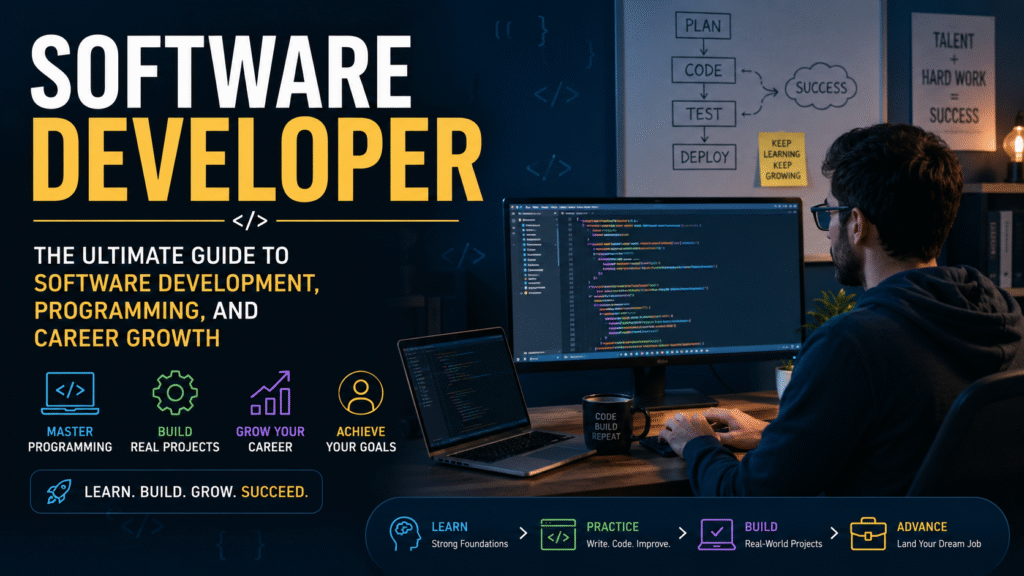
Software Developer: The Ultimate Guide to Software Development, Programming, and Career Growth
- Software Developer: The Ultimate Guide to Software Development, Programming, and Career Growth
- Introduction to Software Development
- What is a Software Developer?
- Why Software Development Matters
- Evolution of Software Development
- Role of Software Developers in Modern Business
- Understanding Software Development
- Definition of Software Development
- Core Components of Software Development
- Types of Software Applications
- Objectives of Software Development
- History and Evolution of Software Development
- Early Computing Systems
- Rise of Programming Languages
- Growth of the Internet
- Software Development in 2026
- Importance of Software Developers
- Business Automation
- Digital Transformation
- Innovation and Product Development
- Customer Experience Improvement
- Types of Software Developers
- Front End Developer
- Back End Developer
- Full Stack Developer
- Mobile App Developer
- Desktop Application Developer
- Game Developer
- DevOps Engineer
- Cloud Developer
- Software Development Life Cycle (SDLC)
- Essential Skills for Software Developers
- Programming Skills
- Problem Solving
- Communication Skills
- Team Collaboration
- Debugging Skills
- Project Management
- Programming Languages for Software Development
- Python
- JavaScript
- Java
- Front End Development
- HTML
- CSS
- JavaScript
- React
- Angular
- Vue.js
- Back End Development
- Node.js
- Python Frameworks
- Database Management
- Full Stack Development
- Software Development Tools
- Git
- GitHub
- Docker
- Jenkins
- Postman
- Web Development
- Website Development Process
- Responsive Design
- User Experience
- Website Performance Optimization
- Mobile App Development
- Android Development
- iOS Development
- Cross-Platform Development
- Software Testing
- Unit Testing
- Integration Testing
- Automated Testing
- Quality Assurance
- Career Guide for Software Developers
- Educational Requirements
- Certifications
- Building a Portfolio
- Internship Opportunities
- Software Developer Salary and Job Opportunities
- Salary Trends
- Remote Work Opportunities
- Top Hiring Industries
- Technology Companies
- Financial Institutions
- Healthcare Organizations
- E-commerce Businesses
- Consulting Firms
- How to Become a Software Developer
- Learning Roadmap
- Choosing a Programming Language
- Building Projects
- Open Source Contributions
- Job Search Strategies
- Common Challenges in Software Development
- Bug Fixing
- Security Issues
- Scalability Challenges
- Technical Debt
- Latest Software Development Trends in 2026
- Artificial Intelligence in Development
- Low-Code and No-Code Platforms
- Cloud Computing
- DevOps Automation
- Cybersecurity
- Future of Software Development
- Frequently Asked Questions (FAQs)
- Conclusion
Introduction to Software Development
In today’s digital world, software powers almost every aspect of our lives. From smartphones and websites to banking systems and cloud platforms, software applications have become essential tools for individuals and businesses. Behind these applications are skilled professionals known as Software Developers.
A Software Developer is responsible for designing, building, testing, deploying, and maintaining software applications. These professionals transform ideas into functional digital solutions that solve real-world problems.
The demand for Software Development professionals continues to grow rapidly as businesses embrace digital transformation. Organizations across industries require talented developers to create innovative products, improve operational efficiency, and enhance customer experiences.
Whether you want to become a Software Engineer, Web Developer, Full Stack Developer, or specialize in another area of technology, understanding software development fundamentals is the first step toward a successful career.
What is a Software Developer?
A Software Developer is a technology professional who creates software applications using various Programming Languages, development tools, and frameworks.
Developers are responsible for:
- Writing code
- Designing software architecture
- Debugging applications
- Testing software
- Maintaining systems
- Implementing new features
Their work helps organizations automate tasks, improve efficiency, and deliver better user experiences.
Modern developers often collaborate with designers, project managers, testers, and business stakeholders to build high-quality applications.
Why Software Development Matters
The importance of Software Development has increased dramatically over the last two decades.
Businesses rely on software for:
Business Operations
Software automates repetitive tasks and streamlines workflows.
Customer Engagement
Applications improve communication and service delivery.
Data Management
Organizations use software to collect, store, and analyze information.
Innovation
New digital products often drive competitive advantages.
Revenue Generation
Many companies generate significant income through software products and online platforms.
As technology continues evolving, skilled Software Developers remain critical contributors to business success.
Evolution of Software Development
The field of software development has undergone significant transformation.
Early Computing Era
Early computers required developers to write machine-level instructions.
High-Level Programming Languages
The introduction of modern Programming Languages simplified development.
Internet Revolution
The growth of the internet created demand for websites and web applications.
Mobile Technology
Smartphones expanded opportunities for mobile application development.
Cloud Computing
Cloud platforms transformed how software is built, deployed, and maintained.
Today, software development encompasses web applications, mobile apps, cloud solutions, AI systems, and much more.
Role of Software Developers in Modern Business
Modern businesses depend heavily on software.
A Software Developer contributes by:
- Building customer-facing applications
- Automating business processes
- Supporting digital transformation
- Developing internal tools
- Enhancing security and performance
Without developers, many organizations would struggle to compete in today’s technology-driven economy.
Understanding Software Development
To fully appreciate the role of a developer, it is important to understand what software development involves.
Definition of Software Development
Software Development is the process of designing, creating, testing, deploying, and maintaining software applications.
The process combines:
- Technical knowledge
- Business understanding
- Problem-solving skills
- Creativity
- Collaboration
The goal is to build reliable solutions that meet user and business requirements.
Core Components of Software Development
Several key components contribute to successful software projects.
Planning
Understanding project objectives and requirements.
Design
Creating system architecture and user interfaces.
Development
Writing source code using Programming Languages.
Testing
Ensuring software functions correctly.
Deployment
Releasing applications to users.
Maintenance
Updating and improving software after launch.
Types of Software Applications
Software can be categorized into several types.
Web Applications
Accessible through browsers and developed by Web Developers.
Mobile Applications
Designed for smartphones and tablets.
Desktop Applications
Installed directly on computers.
Enterprise Software
Supports large-scale business operations.
Cloud Applications
Hosted and delivered through cloud infrastructure.
Each category requires specialized development skills and tools.
Objectives of Software Development
The primary objectives include:
- Solving problems
- Improving efficiency
- Automating processes
- Enhancing user experiences
- Supporting business growth
Effective software development delivers measurable value to users and organizations.
History and Evolution of Software Development
Understanding the history of software development helps explain how the industry has reached its current state.
Early Computing Systems
Early computers were large, expensive machines requiring specialized programming.
Developers worked directly with machine code and assembly language.
This made software creation slow and complex.
Rise of Programming Languages
The development of higher-level Programming Languages revolutionized software creation.
Languages such as:
- FORTRAN
- COBOL
- C
- Java
allowed developers to write more understandable and maintainable code.
Growth of the Internet
The internet transformed software development.
Organizations suddenly needed:
- Websites
- E-commerce platforms
- Online services
- Digital communication systems
This created tremendous demand for Web Developers and software professionals.
Software Development in 2026
Modern development emphasizes:
- Cloud computing
- Artificial intelligence
- Automation
- Cybersecurity
- Mobile-first design
The industry continues evolving rapidly as new technologies emerge.
Importance of Software Developers
The impact of Software Developers extends far beyond writing code.
Business Automation
Software automates repetitive tasks and improves productivity.
Organizations use software to:
- Process transactions
- Manage inventory
- Track performance
- Handle customer interactions
Automation reduces costs and improves efficiency.
Digital Transformation
Many organizations are undergoing digital transformation initiatives.
Developers play a central role in implementing new technologies and modernizing systems.
Innovation and Product Development
Innovative software products often create new business opportunities.
Developers help organizations:
- Launch digital products
- Enter new markets
- Improve customer experiences
Technology-driven innovation remains a key competitive advantage.
Customer Experience Improvement
User-friendly software improves customer satisfaction.
Developers focus on:
- Performance
- Reliability
- Accessibility
- Ease of use
Excellent user experiences contribute directly to business success.
Types of Software Developers
Software development includes several specialized career paths.
Front End Developer
A Front End Developer focuses on the visual and interactive aspects of applications.
Responsibilities include:
- User interfaces
- Responsive design
- User experience optimization
Front-end developers work closely with designers to create engaging digital experiences.
Back End Developer
A Back End Developer manages server-side logic and infrastructure.
Responsibilities include:
- Databases
- APIs
- Authentication systems
- Business logic
Back-end development powers application functionality behind the scenes.
Full Stack Developer
A Full Stack Developer works on both front-end and back-end systems.
This role requires broad technical knowledge and versatility.
Many organizations value full-stack professionals because they can contribute across multiple areas of a project.
Mobile App Developer
Mobile developers create applications for smartphones and tablets.
They often specialize in:
- Android development
- iOS development
- Cross-platform frameworks
The continued growth of mobile technology drives strong demand for these professionals.
Desktop Application Developer
Desktop developers create software designed to run on personal computers.
Examples include:
- Productivity software
- Design tools
- Enterprise applications
Game Developer
Game developers create interactive entertainment experiences.
Responsibilities include:
- Gameplay programming
- Graphics implementation
- Performance optimization
The gaming industry remains a significant employer of software professionals.
DevOps Engineer
A DevOps Engineer focuses on deployment, automation, and infrastructure management.
Responsibilities include:
- Continuous integration
- Continuous deployment
- Monitoring
- Infrastructure automation
DevOps practices improve software delivery efficiency.
Cloud Developer
A Cloud Developer builds applications optimized for cloud environments.
Cloud specialists work with platforms such as:
- AWS
- Azure
- Google Cloud
Cloud computing continues expanding career opportunities.
Software Development Life Cycle (SDLC)
The Software Development Life Cycle provides a structured framework for creating software.
Requirement Analysis
The first stage involves gathering and documenting requirements.
Developers and stakeholders collaborate to understand project goals.
Clear requirements reduce misunderstandings later in the process.
Planning
Planning establishes:
- Timelines
- Budgets
- Resources
- Risk assessments
Effective planning improves project success rates.
Design
Design focuses on:
- Architecture
- Database structures
- User interfaces
- System workflows
A strong design foundation supports efficient development.
Development
During development, programmers write code using various Programming Languages.
This stage transforms designs into working software.
Testing
Software Testing ensures applications function correctly and meet quality standards.
Testing helps identify:
- Bugs
- Performance issues
- Security vulnerabilities
Quality assurance is critical for successful software delivery.
Deployment
Deployment releases software into production environments where users can access it.
Modern deployment processes often involve automation and cloud technologies.
Maintenance
Software requires ongoing maintenance after launch.
Maintenance activities include:
- Bug fixes
- Security updates
- Feature enhancements
- Performance improvements
Continuous maintenance ensures long-term software reliability.
Essential Skills for Software Developers
Becoming a successful Software Developer requires more than simply learning how to write code. Modern software development involves technical expertise, problem-solving abilities, communication skills, and continuous learning.
As technology evolves, developers must constantly update their knowledge and adapt to new tools and methodologies.
Programming Skills
One of the most important Software Developer Skills Required is programming proficiency.
Developers use various Programming Languages to build applications, automate processes, and solve business problems.
Strong programming skills include:
- Writing clean code
- Understanding algorithms
- Data structures
- Object-oriented programming
- Code optimization
Programming serves as the foundation of every software development career.
Problem Solving
Software development is fundamentally about solving problems.
Developers regularly encounter challenges such as:
- System failures
- Performance issues
- Complex business requirements
- Security vulnerabilities
Strong analytical thinking helps developers identify solutions efficiently.
Employers highly value candidates with excellent problem-solving abilities.
Communication Skills
Many people assume software developers work alone, but communication is essential.
Developers frequently collaborate with:
- Designers
- Project managers
- Business analysts
- Clients
- Quality assurance teams
Effective communication ensures project requirements are understood and implemented correctly.
Team Collaboration
Modern software projects often involve multiple developers working together.
Successful collaboration requires:
- Code reviews
- Documentation
- Knowledge sharing
- Agile participation
Strong teamwork contributes significantly to project success.
Debugging Skills
Debugging involves identifying and fixing software issues.
Developers spend considerable time:
- Finding bugs
- Analyzing errors
- Improving code quality
Strong debugging abilities improve productivity and software reliability.
Project Management
While not always mandatory, project management skills provide significant advantages.
Developers who understand project workflows can:
- Prioritize tasks
- Estimate timelines
- Manage risks
- Coordinate effectively with stakeholders
These skills support career growth and leadership opportunities.
Programming Languages for Software Development
Choosing the right Programming Languages is one of the most important decisions for aspiring developers.
Each language offers unique strengths and applications.
Python
Python remains one of the most popular languages in modern Software Development.
Benefits include:
- Easy-to-read syntax
- Large community support
- Extensive libraries
- Versatility
Python is widely used for:
- Web development
- Artificial intelligence
- Data science
- Automation
Many professionals beginning a Software Developer Roadmap 2026 start with Python.
JavaScript
JavaScript powers most interactive websites.
Applications include:
- Dynamic web pages
- User interfaces
- Web applications
- Server-side development
JavaScript is essential for every Front End Developer.
Modern frameworks have further increased its popularity.
Java
Java has remained a leading enterprise programming language for decades.
Advantages include:
- Platform independence
- Security
- Scalability
- Reliability
Many large organizations use Java for mission-critical applications.
C++
C++ provides high performance and low-level control.
Common applications include:
- Game development
- Embedded systems
- Financial software
Developers requiring maximum performance often choose C++.
C#
C# is widely used within the Microsoft ecosystem.
Applications include:
- Enterprise software
- Desktop applications
- Cloud services
- Game development
The language remains highly relevant in modern development environments.
PHP
PHP continues powering millions of websites worldwide.
Common uses include:
- Website development
- Content management systems
- E-commerce platforms
Many Web Developers still rely on PHP for server-side programming.
Go
Go has gained popularity because of its simplicity and performance.
Benefits include:
- Fast execution
- Easy deployment
- Concurrency support
Many cloud-native applications use Go.
Rust
Rust emphasizes:
- Memory safety
- Performance
- Reliability
Organizations increasingly adopt Rust for security-critical systems.
Front End Development
Front-end development focuses on what users see and interact with.
A Front End Developer is responsible for creating visually appealing and functional interfaces.
HTML
HTML serves as the foundation of web pages.
It defines:
- Structure
- Content
- Layout elements
Every website begins with HTML.
CSS
CSS controls the appearance of web pages.
Developers use CSS for:
- Styling
- Layout design
- Responsive interfaces
- Animations
Modern websites rely heavily on CSS for professional presentation.
JavaScript
JavaScript enables interactivity.
Examples include:
- Forms
- Dynamic content
- User interactions
- Real-time updates
It remains the most important front-end programming language.
React
React is one of the most popular front-end frameworks.
Advantages include:
- Reusable components
- Performance optimization
- Large community support
Many organizations use React for modern web applications.
Angular
Angular is a comprehensive framework developed by Google.
Features include:
- Dependency injection
- Component architecture
- Enterprise scalability
Large organizations frequently use Angular for complex projects.
Vue.js
Vue.js is known for its simplicity and flexibility.
Benefits include:
- Easy learning curve
- Lightweight structure
- Rapid development
Many developers appreciate Vue’s approachable design.
Back End Development
Back-end development powers application functionality behind the scenes.
A Back End Developer focuses on servers, databases, APIs, and business logic.
Node.js
Node.js allows JavaScript to run on servers.
Benefits include:
- Fast performance
- Large ecosystem
- Full-stack JavaScript development
Node.js has become a popular choice for scalable web applications.
Python Frameworks
Python offers several powerful frameworks.
Examples include:
Django
Known for security and rapid development.
Flask
Lightweight and flexible.
FastAPI
Optimized for modern API development.
These frameworks simplify back-end application creation.
Java Frameworks
Java developers frequently use frameworks such as:
Spring Boot
One of the most popular enterprise development platforms.
Benefits include:
- Scalability
- Security
- Microservices support
Spring Boot dominates enterprise Java development.
PHP Frameworks
Popular PHP frameworks include:
Laravel
Known for elegance and productivity.
Symfony
Designed for complex enterprise applications.
Frameworks improve development speed and maintainability.
Database Management
Databases store application information.
Developers commonly work with:
Relational Databases
- MySQL
- PostgreSQL
- SQL Server
NoSQL Databases
- MongoDB
- Cassandra
- Redis
Effective database management is essential for every Back End Developer.
Full Stack Development
Full Stack Development combines front-end and back-end expertise.
Professionals in this field work across the entire application stack.
What is a Full Stack Developer?
A Full Stack Developer can build complete applications independently.
Responsibilities include:
- User interface development
- Server-side programming
- Database management
- Deployment
This versatility makes full-stack professionals highly valuable.
Full Stack Technologies
Common full-stack technology stacks include:
MERN Stack
- MongoDB
- Express.js
- React
- Node.js
MEAN Stack
- MongoDB
- Express.js
- Angular
- Node.js
LAMP Stack
- Linux
- Apache
- MySQL
- PHP
Each stack offers unique advantages.
Career Opportunities
The demand for Full Stack Development professionals continues increasing.
Employers appreciate developers capable of contributing across multiple project areas.
Many organizations actively seek candidates following a Full Stack Developer Career Guide learning path.
Software Development Tools
Modern developers rely on various tools to improve productivity and software quality.
Understanding Software Development Tools is essential for career success.
Visual Studio Code
Visual Studio Code is one of the most popular development environments.
Features include:
- Code completion
- Debugging
- Extensions
- Git integration
It supports numerous programming languages and frameworks.
Git
Git is the industry-standard version control system.
Benefits include:
- Code tracking
- Collaboration
- Branch management
- Change history
Every professional developer should understand Git.
GitHub
GitHub provides cloud-based repository hosting.
Developers use GitHub for:
- Collaboration
- Open-source contributions
- Portfolio building
Many employers evaluate GitHub profiles during recruitment.
Docker
Docker simplifies application deployment through containerization.
Advantages include:
- Consistent environments
- Faster deployments
- Scalability
Docker has become a core DevOps technology.
Jenkins
Jenkins supports automation and continuous integration.
It helps organizations:
- Build applications
- Run tests
- Deploy updates
Automation improves development efficiency.
Postman
Postman simplifies API testing and development.
Developers use it to:
- Test endpoints
- Validate responses
- Debug integrations
API testing remains critical in modern software systems.
Web Development
Web Developer roles remain among the most popular technology careers.
Web development focuses on creating websites and web applications.
Website Development Process
A typical website development process includes:
- Requirement gathering
- Design creation
- Front-end development
- Back-end development
- Testing
- Deployment
Following structured processes improves project outcomes.
Responsive Design
Modern websites must function effectively across devices.
Responsive design ensures compatibility with:
- Smartphones
- Tablets
- Laptops
- Desktop computers
User expectations make responsiveness essential.
User Experience
User experience directly impacts engagement and conversions.
Developers focus on:
- Navigation
- Accessibility
- Performance
- Usability
Excellent user experiences contribute to business success.
Website Performance Optimization
Performance optimization improves:
- Loading speed
- User satisfaction
- Search engine rankings
Techniques include:
- Code optimization
- Image compression
- Caching
- Content delivery networks
Fast websites provide competitive advantages.
Mobile App Development
The rise of smartphones has transformed how people interact with technology. Today, businesses, governments, and organizations rely heavily on mobile applications to connect with users and provide services.
As a result, Mobile App Development has become one of the fastest-growing areas within Software Development.
Android Development
Android is the world’s most widely used mobile operating system.
Developers building Android applications commonly use:
- Java
- Kotlin
- Android Studio
Android developers create applications for:
- Smartphones
- Tablets
- Smart TVs
- Wearable devices
Because Android has a large global market share, Android development offers extensive career opportunities.
iOS Development
iOS development focuses on applications designed for Apple devices.
Developers typically use:
- Swift
- Objective-C
- Xcode
iOS applications are known for:
- High performance
- Security
- Premium user experiences
Many organizations prioritize iOS applications because of strong customer engagement.
Cross-Platform Development
Cross-platform development allows developers to create applications that run on multiple operating systems using a single codebase.
Popular frameworks include:
- Flutter
- React Native
- Xamarin
Benefits include:
- Faster development
- Reduced costs
- Easier maintenance
Cross-platform technologies continue gaining popularity among modern Software Developers.
Software Testing
Creating software is only part of the development process. Ensuring software quality is equally important.
Software Testing helps identify issues before applications reach users.
Testing improves:
- Reliability
- Security
- Performance
- User satisfaction
Unit Testing
Unit testing evaluates individual components of software.
Benefits include:
- Early bug detection
- Easier maintenance
- Improved code quality
Developers often automate unit tests as part of their workflow.
Integration Testing
Integration testing verifies that multiple components work together correctly.
Examples include:
- API communication
- Database interactions
- Third-party service integration
Successful integration testing reduces deployment risks.
Automated Testing
Automated testing uses tools and scripts to execute tests automatically.
Advantages include:
- Faster feedback
- Consistency
- Reduced manual effort
Modern development teams increasingly rely on automation.
Quality Assurance
Quality assurance focuses on maintaining software quality throughout the development lifecycle.
QA teams evaluate:
- Functionality
- Performance
- Security
- User experience
Strong QA processes contribute significantly to successful software products.
Career Guide for Software Developers
A Software Developer Career offers numerous opportunities for growth, specialization, and financial success.
Technology remains one of the most dynamic and rewarding industries worldwide.
Educational Requirements
Many developers hold degrees in:
- Computer Science
- Software Engineering
- Information Technology
- Mathematics
However, formal education is no longer the only path into technology careers.
Many successful developers learn through online courses, bootcamps, and self-study.
Certifications
Certifications can strengthen professional credibility.
Popular certifications include:
- AWS Certifications
- Microsoft Certifications
- Google Cloud Certifications
- Cybersecurity Certifications
Professional credentials often improve employment opportunities.
Building a Portfolio
A strong portfolio demonstrates practical skills.
Developers should showcase:
- Personal projects
- Open-source contributions
- Mobile applications
- Websites
- Case studies
Employers frequently evaluate portfolios during hiring decisions.
Internship Opportunities
Internships provide valuable real-world experience.
Benefits include:
- Industry exposure
- Professional networking
- Skill development
- Resume enhancement
Internships often serve as stepping stones toward full-time employment.
Software Developer Salary and Job Opportunities
The demand for skilled developers continues growing across industries.
Organizations increasingly invest in digital solutions, creating strong employment prospects.
Global Demand
Virtually every industry requires software professionals.
Major hiring sectors include:
- Technology
- Healthcare
- Finance
- Education
- Manufacturing
- Government
This broad demand contributes to long-term career stability.
Salary Trends
Compensation varies based on:
- Experience
- Location
- Skills
- Industry
- Certifications
Generally, software development remains one of the highest-paying professional fields.
Individuals researching Software Developer Career Opportunities and Salary often find attractive earning potential across global markets.
Remote Work Opportunities
Remote work has transformed the technology industry.
Benefits include:
- Flexible schedules
- Global employment opportunities
- Improved work-life balance
Many companies now hire developers regardless of geographic location.
Top Hiring Industries
Industries actively recruiting software professionals include:
Technology Companies
Developing products and digital services.
Financial Institutions
Building secure financial systems.
Healthcare Organizations
Supporting patient care and operations.
E-commerce Businesses
Creating online shopping experiences.
Consulting Firms
Delivering technology solutions to clients.
The demand for skilled developers remains strong across all sectors.
How to Become a Software Developer
Many aspiring professionals ask, How to Become a Software Developer successfully.
A structured learning approach can significantly improve outcomes.
Learning Roadmap
A practical Software Developer Roadmap 2026 may include:
- Learning programming fundamentals
- Understanding data structures
- Studying algorithms
- Building projects
- Learning databases
- Understanding software architecture
- Exploring cloud technologies
- Creating a portfolio
Following a roadmap provides clear direction and measurable progress.
Choosing a Programming Language
Selecting an initial language depends on career goals.
Popular beginner-friendly options include:
- Python
- JavaScript
- Java
When evaluating the Best Programming Languages for Developers, consider:
- Learning curve
- Industry demand
- Career objectives
Consistency is more important than choosing the “perfect” language.
Building Projects
Practical experience is essential.
Many learners use Software Development Project Ideas to strengthen skills.
Examples include:
- Task management applications
- E-commerce platforms
- Portfolio websites
- Mobile applications
- API integrations
Projects demonstrate problem-solving abilities and technical competence.
Open Source Contributions
Open-source participation offers several benefits:
- Real-world experience
- Community engagement
- Portfolio enhancement
- Networking opportunities
Many employers value open-source contributions.
Job Search Strategies
Successful job searches often involve:
- Networking
- Portfolio development
- Technical interview preparation
- Resume optimization
- Continuous learning
Candidates who combine technical expertise with professional skills often achieve better results.
Common Challenges in Software Development
Despite its rewards, software development presents several challenges.
Understanding these challenges helps developers prepare effectively.
Bug Fixing
Software bugs are inevitable.
Developers spend significant time:
- Diagnosing issues
- Debugging code
- Testing solutions
Strong analytical skills help resolve problems efficiently.
Security Issues
Cybersecurity has become a critical concern.
Developers must address:
- Data protection
- Authentication
- Authorization
- Vulnerability prevention
Secure coding practices are increasingly important.
Scalability Challenges
Applications often need to support growing numbers of users.
Scalability requires:
- Efficient architecture
- Performance optimization
- Infrastructure planning
Poor scalability can negatively impact user experiences.
Technical Debt
Technical debt occurs when short-term solutions create future maintenance challenges.
Managing technical debt requires:
- Refactoring
- Documentation
- Code quality improvements
Organizations that address technical debt proactively often experience better long-term outcomes.
Latest Software Development Trends in 2026
Technology evolves rapidly, and developers must stay informed about emerging trends.
Artificial Intelligence in Development
Artificial intelligence is transforming software creation.
AI-powered tools assist with:
- Code generation
- Bug detection
- Documentation
- Testing
Developers increasingly collaborate with AI systems to improve productivity.
Low-Code and No-Code Platforms
Low-code and no-code platforms simplify application creation.
Benefits include:
- Faster development
- Reduced technical barriers
- Increased accessibility
While these platforms will not replace developers, they continue expanding opportunities.
Cloud Computing
Cloud technologies remain central to modern Software Engineering.
Benefits include:
- Scalability
- Reliability
- Cost efficiency
Organizations increasingly migrate systems to cloud environments.
DevOps Automation
The role of the DevOps Engineer continues expanding.
Automation supports:
- Continuous integration
- Continuous deployment
- Monitoring
- Infrastructure management
DevOps practices improve software delivery speed and quality.
Cybersecurity
Security remains a top priority.
Developers must understand:
- Secure coding
- Threat detection
- Compliance requirements
Cybersecurity expertise continues increasing in value.
Future of Software Development
The future of Software Development will be shaped by innovation, automation, and emerging technologies.
AI-Assisted Coding
AI-powered coding tools will continue improving developer productivity.
Benefits include:
- Faster development
- Improved code quality
- Reduced repetitive tasks
Developers who embrace AI tools may gain competitive advantages.
Quantum Computing
Although still emerging, quantum computing has the potential to revolutionize computing capabilities.
Future applications may include:
- Advanced simulations
- Cryptography
- Scientific research
Developers may eventually need to understand quantum programming concepts.
Edge Computing
Edge computing brings processing closer to users and devices.
Advantages include:
- Reduced latency
- Improved performance
- Better real-time processing
This trend will influence future application architectures.
Automation and Innovation
Automation will continue transforming software workflows.
Developers will increasingly focus on:
- Strategic problem-solving
- Innovation
- System design
Routine tasks will become more automated.
Frequently Asked Questions (FAQs)
What Does a Software Developer Do?
A Software Developer designs, builds, tests, deploys, and maintains software applications.
Their responsibilities include coding, debugging, testing, and collaborating with stakeholders.
Is Software Development a Good Career?
Yes. A Software Developer Career offers strong demand, competitive salaries, diverse opportunities, and long-term growth potential.
Which Programming Language Should Beginners Learn?
Python and JavaScript are often recommended because of their simplicity and widespread adoption.
Both are excellent starting points for aspiring developers.
How Long Does It Take to Become a Software Developer?
The timeline varies depending on learning methods and dedication.
Many individuals following a Learn Software Development Step by Step approach can develop job-ready skills within one to two years.
What is the Average Software Developer Salary?
Salaries vary by experience, location, industry, and specialization.
However, software development consistently ranks among the highest-paying professional careers globally.
Conclusion
The role of a Software Developer has become one of the most important and influential careers in the digital economy. From building websites and mobile applications to creating enterprise software and cloud-based solutions, developers drive innovation across industries.
By mastering Programming Languages, understanding the Software Development Life Cycle, learning modern Software Development Tools, and developing strong Coding Skills, aspiring professionals can build successful and rewarding careers.
Whether your goal is becoming a Front End Developer, Back End Developer, Full Stack Developer, Web Developer, Cloud Developer, or DevOps Engineer, the opportunities within software development continue expanding rapidly.
Following a structured Software Developer Training Program, gaining practical experience through projects, contributing to open-source initiatives, and continuously learning new technologies can help professionals remain competitive in this evolving industry.
As artificial intelligence, cloud computing, automation, and cybersecurity continue shaping the future, developers who adapt and embrace innovation will be well-positioned for long-term success in the world of Software Engineering and Software Development.