
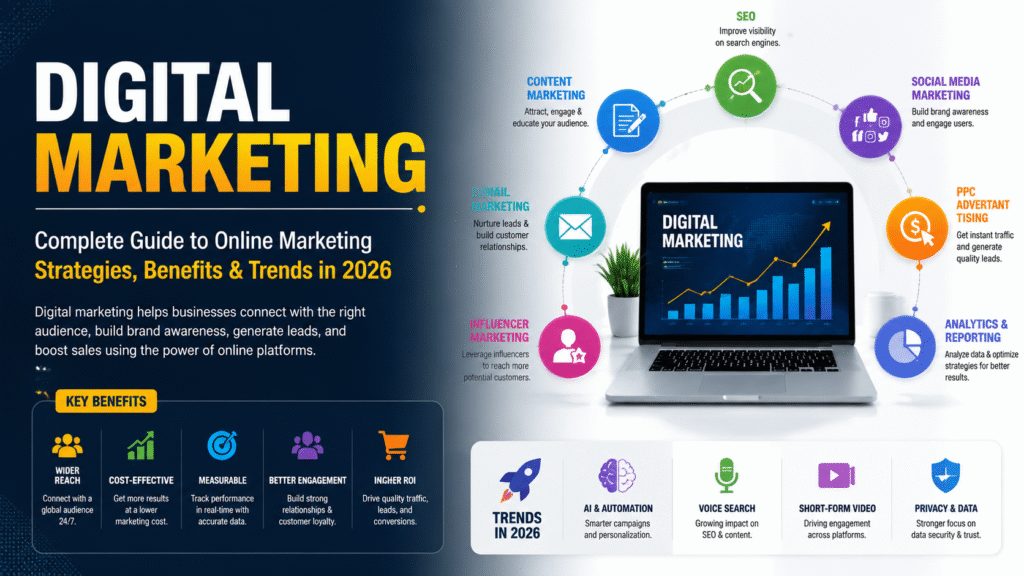
Digital Marketing: Complete Guide to Online Marketing Strategies, Benefits & Trends in 2026
- Digital Marketing: Complete Guide to Online Marketing Strategies, Benefits & Trends in 2026
- What is Digital Marketing?
- History and Evolution of Digital Marketing
- Benefits of Digital Marketing
- Types of Digital Marketing
- Off-Page SEO
- Technical SEO
- Local SEO
- SEO Best Practices
- Social Media Marketing
- Facebook Marketing
- Instagram Marketing
- LinkedIn Marketing
- YouTube Marketing
- Twitter (X) Marketing
- Content Marketing Strategy
- Blog Marketing
- Video Content
- Infographics
- Case Studies
- Content Distribution
- PPC Advertising
- Google Ads
- Meta Ads
- Display Advertising
- Retargeting Campaigns
- Email Marketing
- Lead Nurturing
- Conversion Optimization
- Digital Marketing Tools
- Google Analytics
- Google Search Console
- SEMrush
- Ahrefs
- Canva
- HubSpot
- Latest Digital Marketing Trends in 2026
- AI-Powered Marketing
- Voice Search Optimization
- Video-First Marketing
- Personalization
- Marketing Automation
- How to Create a Digital Marketing Strategy
- Common Digital Marketing Mistakes to Avoid
- Not Tracking Analytics
- Future of Digital Marketing
- AI and Automation
- Privacy-Focused Marketing
- Emerging Technologies
- Frequently Asked Questions (FAQs)
- Conclusion
What is Digital Marketing?
In today’s technology-driven world, businesses no longer rely solely on newspapers, billboards, radio advertisements, or television commercials to reach customers. The internet has transformed how people search for products, compare services, and make purchasing decisions. This transformation has given rise to digital marketing, one of the most powerful business growth strategies available today.

Digital marketing refers to the promotion of products, services, and brands using online channels and digital technologies. These channels include search engines, websites, social media platforms, email, mobile applications, and online advertising networks. Unlike traditional marketing methods, digital marketing allows businesses to reach targeted audiences, measure campaign performance in real time, and optimize marketing efforts for better results.
Whether a company is a startup, small business, local service provider, eCommerce store, or multinational corporation, digital marketing has become essential for attracting customers and increasing revenue. The ability to connect with consumers at every stage of their buying journey makes digital marketing one of the most effective and measurable forms of marketing ever created.
Digital marketing encompasses multiple strategies, including Search Engine Optimization (SEO), Pay-Per-Click Advertising (PPC), Social Media Marketing (SMM), Content Marketing, Email Marketing, Affiliate Marketing, Influencer Marketing, and Video Marketing. Each of these methods serves a unique purpose while contributing to an overall online marketing strategy.
As internet usage continues to grow worldwide, businesses that invest in digital marketing gain a significant competitive advantage. They can build brand awareness, generate leads, increase sales, and develop lasting relationships with customers.
How Digital Marketing Works
Digital marketing works by connecting businesses with potential customers through various online channels. Every digital marketing strategy begins with understanding the target audience and identifying where those users spend their time online.
When a business launches a digital marketing campaign, it typically starts by creating valuable content or advertisements designed to attract attention. These marketing assets are then distributed through search engines, social media platforms, email campaigns, or paid advertising networks.

For example, when a user searches for a service on Google, websites optimized through SEO can appear in search results. If a business runs Google Ads campaigns, its advertisements may also appear at the top of search engine results pages. When users click those links, they are directed to landing pages or websites where they can learn more about products and services.
Social media marketing operates similarly. Businesses create engaging content and advertisements that appear on platforms such as Facebook, Instagram, LinkedIn, and YouTube. Users interact with that content, visit websites, and potentially become customers.
Email marketing helps nurture leads by delivering personalized messages directly to subscribers. Content marketing educates audiences through blogs, videos, guides, and articles. Together, these channels create a complete customer journey from awareness to conversion.
One of the biggest advantages of digital marketing is its ability to track performance. Businesses can measure clicks, impressions, conversions, engagement rates, and revenue generated from each campaign. This data helps marketers continuously improve results.
Importance of Digital Marketing in Modern Business
Digital marketing has become essential because consumer behavior has changed dramatically. Most customers begin their buying journey online. Before making a purchase, they research products, read reviews, compare prices, and seek recommendations through digital channels.
Businesses that fail to establish a strong online presence risk losing potential customers to competitors. A company may offer excellent products or services, but if people cannot find it online, growth opportunities become limited.
Digital marketing allows businesses to be visible exactly when customers are searching for solutions. Through SEO and paid advertising, companies can appear in front of highly targeted audiences who are actively interested in their offerings.
Another reason digital marketing is important is its cost-effectiveness. Traditional advertising often requires large budgets and provides limited tracking capabilities. Digital marketing enables businesses of all sizes to compete effectively, even with modest marketing budgets.
Furthermore, digital marketing supports customer engagement. Brands can communicate directly with audiences through social media, email, and live chat systems. This interaction helps build trust, loyalty, and long-term relationships.
The importance of digital marketing will continue to increase as technology evolves. Businesses that embrace digital strategies today position themselves for sustainable growth in the future.
History and Evolution of Digital Marketing
The history of digital marketing began alongside the growth of the internet. In the early days, businesses primarily used websites as online brochures. As search engines evolved, companies started optimizing websites to improve visibility.
The late 1990s and early 2000s saw the rise of search engines such as Google, creating new opportunities for online advertising and SEO. Businesses quickly realized that appearing on the first page of search results could drive significant traffic and sales.
Social media platforms transformed digital marketing even further. Websites like Facebook, YouTube, LinkedIn, Instagram, and Twitter allowed brands to connect directly with consumers and build communities around their products and services.
The emergence of smartphones accelerated digital marketing growth. Mobile devices enabled users to access information anytime and anywhere, increasing the importance of mobile-friendly websites and mobile advertising.
Artificial intelligence, automation, data analytics, and machine learning are now shaping the next phase of digital marketing evolution. These technologies help marketers deliver personalized experiences and optimize campaigns more effectively than ever before.
Traditional Marketing vs Digital Marketing
Traditional marketing includes newspapers, magazines, television commercials, radio advertisements, direct mail campaigns, and outdoor billboards. While these methods still have value, they often require significant budgets and provide limited audience targeting.
Digital marketing offers several advantages over traditional marketing.
Traditional marketing generally reaches broad audiences, whereas digital marketing targets specific demographics, interests, locations, and behaviors. This precision increases campaign effectiveness and reduces wasted advertising spend.
Traditional campaigns can be difficult to measure accurately. Digital marketing provides detailed analytics that show exactly how users interact with marketing materials.
Traditional advertising often involves long production cycles and high costs. Digital campaigns can be launched quickly and adjusted based on performance data.
Because of these benefits, many businesses allocate a growing percentage of their marketing budgets to digital channels.
Growth of Online Marketing
Online marketing has experienced remarkable growth over the past two decades. Increased internet penetration, smartphone adoption, and social media usage have created unprecedented opportunities for businesses.
Consumers now spend significant portions of their daily lives online. They browse websites, watch videos, interact on social media, and shop through eCommerce platforms. This behavior has made online marketing one of the most effective methods for reaching potential customers.
Businesses increasingly invest in SEO, content marketing, paid advertising, and social media campaigns because these channels consistently generate measurable results. The growth of online marketing shows no signs of slowing down as digital technologies continue to advance.
Digital Marketing in 2026
Digital marketing in 2026 is becoming more intelligent, automated, and personalized. Artificial intelligence is helping businesses create content, optimize campaigns, and analyze customer behavior more efficiently.
Voice search is changing how people interact with search engines. Marketers must optimize content for conversational search queries and natural language processing.
Video content continues to dominate digital platforms. Short-form videos, live streaming, and interactive content attract high levels of engagement.
Privacy regulations are also influencing marketing strategies. Businesses must prioritize transparency, consent, and ethical data collection practices.
As competition increases, successful digital marketers focus on delivering valuable experiences rather than simply promoting products.
Benefits of Digital Marketing
Digital marketing offers numerous benefits that make it one of the most valuable investments for modern businesses.
Global Reach
One of the greatest advantages of digital marketing is its ability to reach audiences worldwide. Unlike traditional marketing, which is often limited by geography, digital channels allow businesses to connect with customers across different countries and regions.
A company operating from a single location can sell products internationally through eCommerce platforms, search engines, and social media networks. This expanded reach creates significant growth opportunities.
Cost-Effective Marketing
Digital marketing is often more affordable than traditional advertising. Businesses can launch campaigns with relatively small budgets and scale them as results improve.
SEO, content marketing, email marketing, and social media marketing provide long-term value while requiring lower investment compared to television or print advertising.
This affordability makes digital marketing accessible to startups and small businesses.
Better Return on Investment (ROI)
Because digital campaigns are highly measurable, businesses can identify which strategies generate the best results. Marketing budgets can then be allocated toward the highest-performing channels.
This data-driven approach improves efficiency and maximizes return on investment.
Real-Time Analytics
Digital marketing platforms provide instant access to performance data. Marketers can monitor website traffic, conversion rates, click-through rates, engagement metrics, and sales performance in real time.
This visibility allows businesses to make informed decisions and optimize campaigns continuously.
Targeted Advertising
One of the most powerful benefits of digital marketing is audience targeting. Advertisers can reach users based on demographics, interests, online behaviors, locations, devices, and purchasing habits.
Targeted advertising increases relevance and improves campaign performance because marketing messages are delivered to the people most likely to become customers.
Businesses can create highly personalized experiences that resonate with specific audience segments, resulting in higher engagement and conversion rates.
Types of Digital Marketing
Digital marketing is a broad field that includes multiple marketing channels and strategies. Each type of digital marketing serves a specific purpose and helps businesses achieve different objectives. Understanding these marketing channels is essential for creating an effective online marketing strategy.
The most successful businesses do not rely on a single marketing method. Instead, they combine multiple digital marketing techniques to reach customers at different stages of the buying journey.
Let’s explore each type of digital marketing in detail.
Search Engine Optimization (SEO)

Search Engine Optimization, commonly known as SEO, is the process of improving a website’s visibility in search engine results. When users search for information, products, or services on search engines, SEO helps websites appear higher in organic search results.
SEO is one of the most valuable forms of digital marketing because it generates targeted traffic without requiring businesses to pay for every visitor.
When properly implemented, SEO can drive long-term traffic, improve brand credibility, and increase sales.
Search engines evaluate hundreds of ranking factors when determining which websites should appear in search results. SEO focuses on optimizing these factors to improve rankings.
Why SEO is Important
Most internet users click on results that appear on the first page of search engines. Websites that rank higher receive significantly more traffic than those appearing on later pages.
SEO helps businesses:
- Increase website traffic
- Improve online visibility
- Generate qualified leads
- Build brand authority
- Enhance user experience
- Increase conversions
SEO is considered a long-term strategy because results often take time to develop. However, the benefits can last for years when maintained properly.
On-Page SEO
On-page SEO refers to optimizations performed directly on a website.
This includes:
Keyword Optimization
Keywords are the words and phrases users type into search engines. Effective keyword research helps businesses understand what their audience is searching for.

Keywords should naturally appear in:
- Titles
- Headings
- URLs
- Meta descriptions
- Content
- Image alt text
High-Quality Content
Content is one of the most important ranking factors.
Search engines prioritize content that:
- Answers user questions
- Provides valuable information
- Demonstrates expertise
- Remains relevant and updated
Internal Linking
Internal links connect pages within the same website.
Benefits include:
- Improved navigation
- Better user experience
- Stronger page authority distribution
- Faster search engine crawling
Optimized Meta Tags
Meta titles and descriptions influence click-through rates and search visibility.
Properly optimized meta tags help search engines understand page content while encouraging users to visit the website.
Off-Page SEO
Off-page SEO focuses on actions taken outside the website to improve rankings.
The primary goal is building authority and trust.
Link Building
Backlinks are links from other websites pointing to your site.
High-quality backlinks signal to search engines that your content is valuable and trustworthy.
Effective link-building strategies include:
- Guest blogging
- Digital PR
- Resource page outreach
- Content promotion
- Industry partnerships
Brand Mentions
Search engines increasingly recognize brand mentions across the web, even when they do not include direct links.
Strong online brand visibility contributes to authority and credibility.
Social Signals
Although social media activity may not directly impact rankings, strong engagement often leads to increased visibility, traffic, and backlinks.
Technical SEO
Technical SEO ensures that search engines can efficiently crawl, index, and understand a website.
Important technical SEO elements include:
Website Speed
Fast-loading websites provide better user experiences and often achieve higher rankings.
Mobile Optimization
Since most searches occur on mobile devices, websites must be mobile-friendly.
Secure Website (HTTPS)
Security is an important ranking factor.
HTTPS protects user data and builds trust.
XML Sitemaps
Sitemaps help search engines discover website pages efficiently.
Structured Data
Schema markup helps search engines understand content and can improve search result appearance.
Local SEO
Local SEO focuses on improving visibility for location-based searches.
For example:
- Digital marketing agency near me
- SEO services in Delhi
- Best web development company nearby
Local SEO includes:
- Google Business Profile optimization
- Local citations
- Customer reviews
- Local content creation
- Location-based keywords
Businesses serving local customers can benefit significantly from local SEO strategies.
SEO Best Practices
To achieve long-term SEO success:
- Publish valuable content regularly
- Focus on user experience
- Optimize website speed
- Build quality backlinks
- Conduct keyword research
- Monitor rankings
- Update outdated content
- Follow search engine guidelines
SEO is a continuous process that requires ongoing optimization and improvement.
Social Media Marketing
Social Media Marketing (SMM) involves promoting brands, products, and services through social media platforms.
Billions of people use social media daily, making it one of the most powerful digital marketing channels available.
Social media helps businesses:

- Increase brand awareness
- Engage customers
- Drive website traffic
- Generate leads
- Build communities
- Improve customer service
Successful social media marketing combines content creation, audience engagement, and paid advertising.
Facebook Marketing
Facebook remains one of the largest social media platforms in the world.
Businesses use Facebook for:
- Brand promotion
- Community building
- Lead generation
- Customer support
- Paid advertising
Facebook Ads allow precise audience targeting based on demographics, interests, and behavior.
This targeting capability makes Facebook an effective marketing platform for businesses of all sizes.
Instagram Marketing
Instagram focuses heavily on visual content.
Businesses use Instagram to:
- Showcase products
- Share brand stories
- Build engagement
- Collaborate with influencers
- Run advertising campaigns
Features such as Stories, Reels, and Shopping enhance marketing opportunities.
Visual content often performs exceptionally well on Instagram.
LinkedIn Marketing
LinkedIn is the leading professional networking platform.
It is especially valuable for:
- B2B marketing
- Professional services
- Recruitment
- Thought leadership
- Business networking
Companies use LinkedIn to connect with decision-makers and industry professionals.
YouTube Marketing
Video content continues to grow in popularity.
YouTube marketing helps businesses:
- Educate audiences
- Demonstrate products
- Increase brand awareness
- Improve search visibility
- Generate leads
Videos often remain relevant for years, making YouTube a valuable long-term marketing channel.
Twitter (X) Marketing
Twitter enables real-time communication and trend participation.
Businesses use Twitter to:
- Share updates
- Engage audiences
- Provide customer support
- Promote content
- Monitor industry conversations
Quick communication makes Twitter effective for brand visibility and engagement.
Content Marketing Strategy
Content marketing focuses on creating and distributing valuable information that attracts and engages target audiences.
Rather than directly selling products, content marketing educates users and builds trust.
This trust eventually influences purchasing decisions.
Content marketing supports SEO, social media marketing, email marketing, and lead generation efforts.
Blog Marketing
Blogging remains one of the most effective content marketing strategies.
High-quality blog posts can:
- Increase organic traffic
- Improve search rankings
- Build authority
- Generate leads
- Educate customers
Successful blogs focus on solving problems and answering user questions.
Video Content
Video has become one of the most consumed content formats online.
Benefits include:
- Higher engagement
- Improved retention
- Better conversion rates
- Increased social sharing
Businesses create tutorials, demonstrations, interviews, webinars, and promotional videos.
Infographics
Infographics present complex information visually.
Benefits include:
- Improved understanding
- Increased shareability
- Better engagement
- Strong backlink opportunities
Well-designed infographics can attract significant traffic and brand exposure.
Case Studies
Case studies demonstrate real-world success stories.
They provide evidence of results and help build trust with potential customers.
Case studies often include:
- Challenges
- Solutions
- Implementation
- Outcomes
- Key lessons
Content Distribution
Creating great content is only half the process.
Content must also be distributed effectively through:
- Search engines
- Social media
- Email marketing
- Industry communities
- Paid promotion
Distribution increases content visibility and reach.
PPC Advertising
Pay-Per-Click (PPC) advertising allows businesses to pay for targeted traffic.
Advertisers only pay when users click on advertisements.
PPC provides immediate visibility and measurable results.
Unlike SEO, which takes time, PPC can generate traffic instantly.
Google Ads

Google Ads is one of the most popular PPC platforms.
Businesses can display advertisements:
- In search results
- On websites
- On YouTube
- In mobile applications
Google Ads helps businesses reach users actively searching for products and services.
Meta Ads
Meta Ads include advertising on Facebook and Instagram.
Benefits include:
- Advanced audience targeting
- Multiple ad formats
- Remarketing opportunities
- Large user base
Meta Ads are widely used for lead generation and eCommerce marketing.
Display Advertising
Display advertising uses visual banner advertisements placed across websites and applications.
These ads help:
- Increase awareness
- Retarget visitors
- Promote products
- Support branding campaigns
Display advertising expands marketing reach beyond search engines.
Retargeting Campaigns
Many website visitors leave without taking action.
Retargeting helps reconnect with those users.
Retargeting advertisements remind users about products or services they previously viewed, increasing conversion opportunities.
Because these users already demonstrated interest, retargeting often produces strong results.
Email Marketing

Email marketing remains one of the highest ROI digital marketing channels.
It allows businesses to communicate directly with customers and prospects.
Email marketing supports:
- Lead nurturing
- Customer retention
- Product promotion
- Relationship building
- Sales growth
When executed correctly, email marketing delivers personalized experiences that drive engagement and conversions.
Building an Email List
An email list is one of a company’s most valuable marketing assets.
Businesses build lists through:
- Website forms
- Lead magnets
- Newsletter subscriptions
- Webinars
- Free resources
Growing a permission-based email list ensures higher engagement and compliance.
Email Automation
Automation allows marketers to send emails based on user behavior.
Examples include:
- Welcome sequences
- Follow-up emails
- Abandoned cart reminders
- Product recommendations
Automation improves efficiency while delivering personalized communication.
Lead Nurturing
Most prospects do not purchase immediately.
Lead nurturing provides relevant information over time to guide prospects through the buying process.
This approach builds trust and increases conversion rates.
Conversion Optimization
Successful email marketing focuses on conversions.
Optimization techniques include:
- Personalized subject lines
- Strong calls-to-action
- Audience segmentation
- Mobile-friendly design
- A/B testing
Continuous improvement helps maximize campaign performance and revenue.
Digital Marketing Tools

Digital marketing success depends not only on strategy but also on using the right tools. Modern marketing tools help businesses analyze performance, automate tasks, optimize campaigns, and improve decision-making.
The right combination of tools can significantly increase productivity while helping marketers achieve better results.
Below are some of the most widely used digital marketing tools.
Google Analytics
Google Analytics is one of the most important tools for digital marketers.
It helps businesses understand how visitors interact with their websites.
Using Google Analytics, marketers can monitor:
- Website traffic
- Visitor behavior
- Traffic sources
- User demographics
- Conversion rates
- Revenue performance
By analyzing this data, businesses can identify strengths, weaknesses, and opportunities for improvement.
Google Analytics helps marketers make informed decisions based on actual user behavior rather than assumptions.
Google Search Console
Google Search Console is a free tool that helps website owners monitor search engine performance.
The platform provides valuable information about:
- Search rankings
- Keyword performance
- Indexing status
- Technical SEO issues
- Website health
Marketers can identify pages that need optimization and discover new keyword opportunities through Search Console reports.
The tool is essential for maintaining strong SEO performance.
SEMrush
SEMrush is a comprehensive digital marketing platform.
It provides tools for:
- Keyword research
- Competitor analysis
- Site audits
- Rank tracking
- Content optimization
- Backlink analysis
Businesses use SEMrush to gain competitive insights and improve their search visibility.
The platform is especially useful for SEO professionals and content marketers.
Ahrefs
Ahrefs is another powerful SEO tool used by marketers worldwide.
Its capabilities include:
- Backlink analysis
- Keyword research
- Competitor tracking
- Content analysis
- Site audits
Ahrefs is known for its extensive backlink database, making it valuable for link-building campaigns and SEO research.
Canva
Canva simplifies graphic design for marketers.
Businesses use Canva to create:
- Social media graphics
- Presentations
- Advertisements
- Infographics
- Marketing materials
The platform enables non-designers to produce professional-quality visual content quickly and efficiently.
HubSpot
HubSpot is a comprehensive inbound marketing and customer relationship management platform.
Features include:
- Marketing automation
- Email marketing
- Lead management
- CRM integration
- Analytics
- Sales tools
HubSpot helps businesses attract visitors, convert leads, and nurture customer relationships.
Latest Digital Marketing Trends in 2026
Digital marketing continues to evolve rapidly. Businesses that stay ahead of emerging trends gain competitive advantages and improve campaign effectiveness.
Several important trends are shaping digital marketing in 2026.
AI-Powered Marketing
Artificial Intelligence has transformed the digital marketing landscape.
AI assists marketers with:
- Content creation
- Customer segmentation
- Data analysis
- Predictive marketing
- Personalization
- Chatbots
Artificial intelligence helps businesses improve efficiency while delivering more relevant customer experiences.
AI-powered tools can analyze massive amounts of data and identify patterns that humans may overlook.
This enables smarter marketing decisions and better campaign performance.
Voice Search Optimization

Voice search continues to grow as consumers use smart speakers and voice assistants.
People increasingly search using conversational phrases rather than short keywords.
For example:
Instead of searching:
“best digital marketing agency”
Users may ask:
“Which digital marketing agency provides affordable SEO services near me?”
Businesses must optimize content for natural language queries and question-based searches.
Voice search optimization is becoming an important part of modern SEO strategies.
Video-First Marketing
Video remains one of the most effective content formats.
Consumers prefer video because it is engaging, easy to consume, and highly informative.
Popular video formats include:
- Short-form videos
- Product demonstrations
- Tutorials
- Live streaming
- Educational content
- Customer testimonials
Businesses investing in video marketing often experience higher engagement and stronger conversion rates.
Personalization
Modern consumers expect personalized experiences.
Generic marketing messages are becoming less effective.
Personalization involves:
- Customized emails
- Product recommendations
- Personalized content
- Behavioral targeting
- Dynamic website experiences
Businesses that deliver relevant experiences often see higher customer satisfaction and improved marketing results.
Marketing Automation
Marketing automation helps businesses streamline repetitive tasks.
Automation tools can manage:
- Email sequences
- Lead nurturing
- Social media scheduling
- Customer segmentation
- Reporting
Automation improves efficiency while ensuring consistent customer communication.
As technology advances, automation will continue playing a larger role in digital marketing.
How to Create a Digital Marketing Strategy
A successful digital marketing strategy requires careful planning and execution.
Random marketing activities rarely produce consistent results.
Businesses should follow a structured approach when developing digital marketing campaigns.
Set Marketing Goals
Every strategy should begin with clearly defined goals.
Examples include:
- Increasing website traffic
- Generating leads
- Improving sales
- Building brand awareness
- Growing social media audiences
Goals should be measurable, realistic, and aligned with business objectives.
Clear goals provide direction and help evaluate success.
Identify Your Target Audience
Understanding the target audience is critical.
Businesses should analyze:
- Demographics
- Interests
- Behaviors
- Pain points
- Purchasing habits
The better a company understands its audience, the more effective its marketing campaigns become.
Audience research ensures that marketing messages resonate with potential customers.
Choose the Right Marketing Channels
Not every channel works equally well for every business.
Some businesses benefit most from SEO, while others achieve better results through social media or paid advertising.
Common channels include:
- Search engines
- Social media platforms
- Email marketing
- Video platforms
- Paid advertising networks
The ideal mix depends on audience behavior and business goals.
Create a Content Plan
Content serves as the foundation of most digital marketing strategies.
Businesses should develop content that addresses audience needs and interests.
A content plan may include:
- Blog articles
- Videos
- Social media posts
- Email campaigns
- Guides
- Case studies
Consistent content creation helps build authority and trust.
Measure and Optimize Results
Successful digital marketing requires continuous improvement.
Businesses should regularly monitor:
- Website traffic
- Engagement metrics
- Conversion rates
- Return on investment
- Campaign performance
Data-driven optimization helps maximize results and improve efficiency.
Common Digital Marketing Mistakes to Avoid
Many businesses struggle with digital marketing because they repeat common mistakes.
Avoiding these issues can significantly improve performance.
Ignoring SEO
Some businesses focus entirely on paid advertising while neglecting SEO.
Although paid campaigns generate immediate traffic, SEO provides sustainable long-term growth.
Ignoring SEO often results in missed opportunities and increased marketing costs.
Poor Audience Targeting
Marketing to the wrong audience wastes time and money.
Businesses should carefully define target audiences and create relevant messaging.
Effective targeting improves engagement, lead quality, and conversion rates.
Inconsistent Branding
Brand consistency builds recognition and trust.
Businesses should maintain consistent:
- Messaging
- Visual identity
- Tone of voice
- Customer experience
Inconsistent branding can confuse audiences and weaken marketing effectiveness.
Not Tracking Analytics
Without analytics, businesses cannot accurately measure performance.
Marketing decisions should be based on data rather than assumptions.
Tracking metrics enables continuous optimization and improved outcomes.
Future of Digital Marketing
The future of digital marketing will be shaped by technology, data, and evolving consumer expectations.
Several developments are likely to influence future marketing strategies.
AI and Automation

Artificial intelligence will become increasingly integrated into marketing platforms.
Businesses will use AI to:
- Predict customer behavior
- Personalize experiences
- Automate campaigns
- Generate insights
AI-driven marketing will improve efficiency and campaign effectiveness.
Privacy-Focused Marketing
Consumers are becoming more concerned about data privacy.
Businesses must adopt transparent data collection practices and comply with privacy regulations.
Trust will become a critical competitive advantage.
Emerging Technologies
Technologies such as augmented reality, virtual reality, and advanced analytics will create new marketing opportunities.
Businesses that embrace innovation early may gain significant advantages.
The future will reward marketers who combine technology with customer-centric strategies.
Frequently Asked Questions (FAQs)
What is Digital Marketing?
Digital marketing is the promotion of products, services, and brands through online channels such as search engines, social media, websites, email, and digital advertising platforms.
Is Digital Marketing a Good Career?
Yes. Digital marketing is one of the fastest-growing industries globally. Businesses across all sectors require digital marketing professionals, creating strong career opportunities.
How Much Does Digital Marketing Cost?
Costs vary depending on business goals, competition, and marketing channels. Small businesses may start with modest budgets, while larger organizations often invest significantly more.
Which Digital Marketing Channel is Best?
There is no single best channel. The ideal approach depends on business objectives, audience preferences, and available resources. Many successful businesses use a combination of SEO, social media, content marketing, email marketing, and paid advertising.
How Long Does SEO Take?
SEO typically requires several months to produce significant results. However, it provides long-term benefits and sustainable organic traffic when implemented correctly.
Conclusion
Digital marketing has become an essential component of modern business success. As consumers increasingly rely on online platforms to research products, compare services, and make purchasing decisions, businesses must establish strong digital presences to remain competitive.
From Search Engine Optimization and Social Media Marketing to Content Marketing, PPC Advertising, Email Marketing, and Marketing Automation, each digital marketing channel contributes to attracting customers and driving growth.
Successful digital marketing requires strategic planning, audience understanding, valuable content, continuous optimization, and the effective use of technology. Businesses that embrace digital marketing gain the ability to reach targeted audiences, measure results accurately, and scale their operations efficiently.
As technologies such as artificial intelligence, automation, voice search, and personalization continue to evolve, the future of digital marketing will offer even greater opportunities for innovation and growth.
Organizations that invest in learning, adapting, and implementing effective digital marketing strategies today will be best positioned for long-term success in the increasingly digital world of tomorrow.