
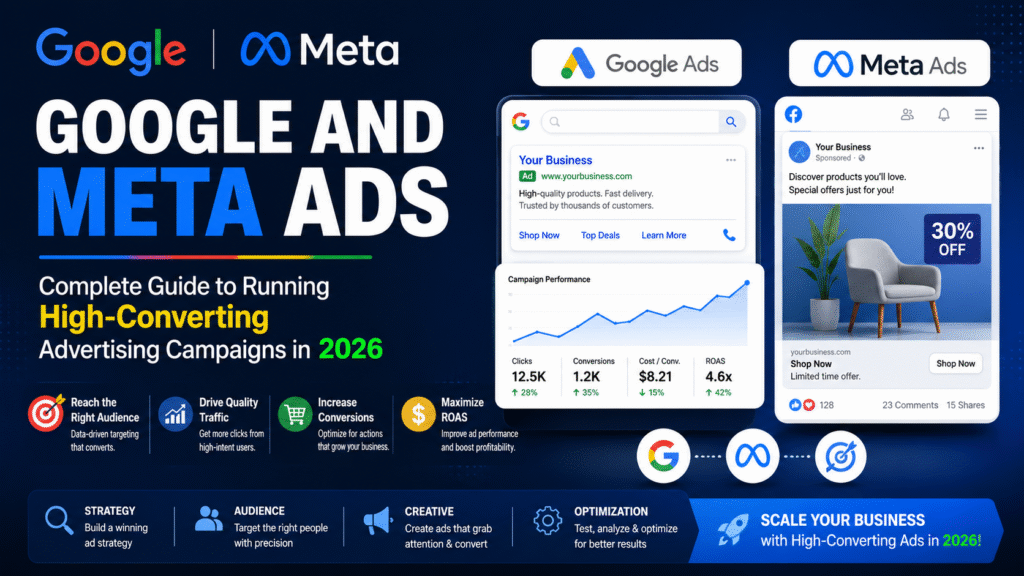
Google and Meta Ads: Complete Guide to Running High-Converting Advertising Campaigns in 2026
- Google and Meta Ads: Complete Guide to Running High-Converting Advertising Campaigns in 2026
- Introduction to Google and Meta Ads
- What Are Google Ads?
- What Are Meta Ads?
- Why Businesses Use Paid Advertising
- Understanding Google Ads
- How Google Ads Works
- Google Ads Auction System
- Google Ads Quality Score
- Types of Google Ads Campaigns
- Understanding Meta Ads
- Types of Meta Ads
- Lead Generation Ads
- Conversion Ads
- Google Ads vs Meta Ads
- Audience Intent Comparison
- Cost Comparison
- Google Ads
- Meta Ads
- Conversion Comparison
- ROI Comparison
- Which Platform is Better?
- Google Analytics Integration
- Tracking Leads and Sales
- Lead Generation Using Google and Meta Ads
- Frequently Asked Questions (FAQs)
- Can I run both platforms together?
- Conclusion
Introduction to Google and Meta Ads
In today’s competitive online marketplace, businesses need more than a website to generate customers and sales. Organic traffic strategies such as SEO are important, but they often require months before significant results appear. This is why businesses of all sizes invest in Google Ads, Meta Ads, PPC Advertising, Online Advertising, Paid Advertising, and Digital Advertising to reach potential customers quickly.
Whether you own a startup, local business, eCommerce store, service company, or enterprise organization, paid advertising platforms provide the ability to place your business directly in front of interested buyers. Modern advertising platforms allow businesses to target users based on demographics, interests, search behavior, location, and online activity.
Among all advertising platforms available today, Google Advertising and Meta’s advertising ecosystem remain the most powerful. Together, these platforms control a significant share of global digital ad spending.
Businesses that successfully implement Google and Meta Ads can generate leads, increase sales, improve brand awareness, and scale revenue faster than relying solely on organic marketing.
What Are Google Ads?
Google Ads is Google’s online advertising platform that enables businesses to display advertisements across Google’s search engine, partner websites, YouTube, mobile applications, and display networks.
When users search for products or services, Google can show sponsored advertisements above organic search results. These advertisements are highly effective because they target users actively searching for solutions.
This makes Google Ads Management one of the most valuable marketing investments for businesses seeking immediate traffic and qualified leads.
For example, if someone searches for “web development services,” Google can display your advertisement directly in front of that user. Since the person is already interested in the service, the likelihood of conversion increases significantly.
Google Ads operates primarily on a pay-per-click model, making it a core component of PPC Advertising strategies.
What Are Meta Ads?
Meta Ads refer to advertisements running across Meta’s platforms, including Facebook, Instagram, Messenger, and Audience Network.
Unlike Google, which targets users based on search intent, Meta focuses heavily on audience interests and behavior.
Businesses use Meta Ads Manager to create, manage, and optimize campaigns.
Meta advertising includes:
- Facebook Ads
- Instagram Ads
- Messenger Ads
- Reels Ads
- Story Ads
- Audience Network Ads
The power of Meta lies in its detailed audience targeting capabilities. Businesses can target users based on age, gender, interests, behaviors, location, education, relationship status, and purchasing activity.
This makes Meta one of the most effective platforms for Facebook Marketing, Instagram Advertising, and customer acquisition.
Why Businesses Use Paid Advertising
Businesses choose Paid Marketing Services because paid advertising delivers measurable and scalable results.
Key benefits include:
Immediate Visibility
Unlike SEO, paid campaigns can begin generating traffic almost immediately.
Precise Audience Targeting
Businesses can target ideal customers with incredible precision.
Scalable Growth
Advertising budgets can increase as campaigns become profitable.
Measurable Results
Platforms provide detailed analytics and performance metrics.
Competitive Advantage
Paid advertising allows smaller businesses to compete with larger competitors.
These advantages explain why Google Ads, Meta Ads, and Advertising Strategy development have become essential parts of modern marketing plans.
How Online Advertising Works
Online Advertising works through sophisticated algorithms that determine which advertisements appear to users.
Advertisers create campaigns and define:
- Target audience
- Budget
- Objectives
- Creative assets
- Landing pages
The advertising platform then uses these inputs to deliver advertisements to relevant users.
Performance is measured through:
- Clicks
- Impressions
- Conversions
- Cost Per Click (CPC)
- Cost Per Lead (CPL)
- Cost Per Acquisition (CPA)
This data allows advertisers to optimize campaigns continuously.
Understanding Google Ads
Overview of Google Ads Platform
The Google Ads platform allows businesses to advertise across multiple Google properties.
These include:
- Google Search
- Google Display Network
- YouTube
- Gmail
- Mobile Apps
Businesses can create highly targeted campaigns designed to achieve specific objectives.
Common objectives include:
- Website traffic
- Lead generation
- Sales
- App downloads
- Brand awareness
The flexibility of the platform makes it suitable for virtually every industry.
How Google Ads Works
Google Ads operates using an auction system.
When users perform a search, advertisers compete for available ad positions.
The winning advertisement is determined by several factors:
Bid Amount
The maximum amount an advertiser is willing to pay.
Ad Relevance
How closely the advertisement matches user intent.
Landing Page Experience
The quality and usefulness of the destination page.
Expected Click-Through Rate
The likelihood users will click the advertisement.
These elements combine to determine ad rankings.
Benefits of Google Ads
Businesses invest in Google Search Ads because they provide several important benefits.
High Purchase Intent
Users searching on Google often have immediate needs.
Fast Results
Traffic can begin immediately after campaign activation.
Precise Keyword Targeting
Businesses can target specific searches.
Advanced Analytics
Detailed reporting enables continuous optimization.
Strong Return on Investment
Well-managed campaigns often produce exceptional ROI.
This is why many businesses prioritize Google Ads for Small Business initiatives.
Google Ads Auction System
Every Google search triggers an automated auction.
Advertisers targeting the keyword enter the auction.
Google evaluates:
- Bid amount
- Quality Score
- Ad relevance
- User experience
The platform then determines which ads appear and their positions.
Understanding this process is essential for successful PPC Campaign Management.
Google Ads Quality Score
Quality Score is Google’s rating of advertisement quality.
Scores are influenced by:
- Keyword relevance
- Ad quality
- Landing page experience
- Historical performance
Higher Quality Scores often lead to:
- Lower costs
- Better ad positions
- Improved performance
Businesses seeking Affordable PPC Services should focus heavily on Quality Score optimization.
Types of Google Ads Campaigns
Google offers multiple campaign formats.
Each serves different business objectives.
Search Ads
Google Search Ads appear within search results and target users actively seeking solutions.
These campaigns often generate highly qualified traffic.
Display Ads
Display campaigns show visual advertisements across websites within Google’s network.
These campaigns are useful for:
- Brand awareness
- Retargeting
- Product promotion
Shopping Ads
Shopping campaigns display products directly within search results.
They are especially effective for eCommerce businesses.
Video Ads
Video campaigns run primarily on YouTube.
They help businesses educate audiences and build brand recognition.
Performance Max Campaigns
Performance Max uses artificial intelligence to automate campaign delivery across Google’s entire advertising ecosystem.
This approach is becoming increasingly important in modern Google Advertising strategies.
App Promotion Ads
Businesses promoting mobile applications can use app campaigns to increase downloads and engagement.
Understanding Meta Ads
Meta advertising focuses on audience discovery rather than search intent.
Users may not actively search for products, but Meta identifies people likely to be interested based on behavior and interests.
This makes Facebook Ads for Lead Generation highly effective.
Businesses frequently use Meta to:
- Generate leads
- Build brand awareness
- Increase engagement
- Drive website traffic
- Boost sales
Meta advertising remains one of the strongest options for Meta Ads for Local Business campaigns.
Benefits of Meta Ads
Meta advertising provides unique advantages.
Advanced Audience Targeting
Detailed demographic and behavioral targeting.
Massive User Base
Billions of active users across Facebook and Instagram.
Multiple Ad Formats
Flexible creative options.
Cost Efficiency
Often lower costs compared to certain search campaigns.
Remarketing Opportunities
Powerful retargeting capabilities improve conversion rates.
These benefits explain why businesses increasingly invest in Meta Ads Campaign Strategy development.
Audience-Based Advertising
Unlike Google search advertising, Meta focuses on audience interests and behaviors.
Targeting options include:
- Demographics
- Interests
- Behaviors
- Purchase activity
- Custom audiences
- Lookalike audiences
This enables businesses to reach highly relevant users.
Such capabilities are especially useful for Small Business Advertising Tips and growth-focused campaigns.
Meta Ad Delivery System
Meta’s algorithm determines advertisement delivery based on:
- Campaign objectives
- Audience quality
- Engagement likelihood
- Bid strategy
- Ad quality
The platform continuously learns and improves performance through machine learning.
This makes campaign optimization an ongoing process rather than a one-time task.
Types of Meta Ads
One of the biggest advantages of Meta Ads is the variety of ad formats available. Businesses can choose different formats based on their marketing objectives, audience behavior, and campaign goals.
A successful Meta Ads Campaign Strategy often combines multiple ad formats to maximize reach and engagement.
Facebook Feed Ads
Facebook Ads displayed in the user’s news feed are among the most common Meta ad formats.
These ads blend naturally with organic content, making them less intrusive and more engaging.
Businesses use Facebook Feed Ads to:
- Generate website traffic
- Increase engagement
- Promote products
- Generate leads
- Drive sales
Because users spend significant time scrolling through Facebook feeds, these ads provide excellent visibility.
For many businesses, Facebook Ads for Lead Generation remain one of the highest-performing advertising solutions available.
Instagram Feed Ads
Instagram Ads appear directly within user feeds.
Instagram’s visual-first environment makes it particularly effective for:
- Fashion brands
- Restaurants
- Beauty products
- Fitness businesses
- E-commerce stores
Strong visuals often produce better engagement and conversion rates.
Businesses investing in Instagram Advertising should prioritize high-quality images and videos.
Story Ads
Stories have become one of the most popular content formats on social media.
Story Ads appear between user-generated stories and provide a full-screen experience.
Benefits include:
- High visibility
- Mobile-first design
- Strong engagement
- Interactive features
Businesses frequently use Story Ads to drive quick actions and website visits.
Reels Ads
Short-form video content continues to dominate social media consumption.
Reels Ads allow advertisers to reach users who consume video content regularly.
Benefits include:
- Increased engagement
- Better reach
- Strong audience retention
- Improved brand awareness
Many experts consider Reels a critical component of modern Digital Advertising strategies.
Messenger Ads
Messenger Ads appear within Facebook Messenger.
These campaigns encourage direct conversations between businesses and potential customers.
Messenger Ads work particularly well for:
- Service providers
- Local businesses
- Customer support
- Appointment bookings
Lead Generation Ads
Lead Ads allow users to submit contact information without leaving Facebook or Instagram.
These campaigns simplify the conversion process and often improve lead generation performance.
Businesses offering:
- Consulting services
- Real estate services
- Marketing services
- Software solutions
often rely heavily on Lead Generation Ads.
Conversion Ads
Conversion campaigns focus on driving specific actions.
Examples include:
- Purchases
- Form submissions
- App installations
- Registrations
These campaigns are essential for businesses focused on measurable results.
Google Ads vs Meta Ads
One of the most common questions businesses ask is:
Which platform performs better—Google Ads or Meta Ads?
The answer depends on business goals, target audience, and industry.
Audience Intent Comparison
Google users actively search for solutions.
For example:
- “web development company”
- “digital marketing agency”
- “best SEO services”
These users already demonstrate buying intent.
Meta users, however, are browsing content rather than searching for products.
Meta identifies potential customers based on interests and behavior.
This distinction significantly impacts campaign strategy.
Cost Comparison
Advertising costs vary by industry and competition.
Generally:
Google Ads
- Higher CPC
- Higher purchase intent
- Faster conversions
Meta Ads
- Lower CPC
- Greater audience reach
- Better brand awareness
Businesses seeking Budget-Friendly Online Advertising often begin with Meta campaigns.
Conversion Comparison
Google frequently generates faster conversions because users are actively searching.
Meta often excels at:
- Brand awareness
- Lead generation
- Audience building
- Retargeting
Successful advertisers frequently combine both platforms.
ROI Comparison
Return on investment depends on campaign quality.
Many businesses achieve excellent ROI from:
- Google Ads Management
- Meta Ads Manager
- Retargeting campaigns
- Conversion optimization
The best strategy often involves integrating both platforms.
Which Platform is Better?
If your goal is immediate lead generation, Google may perform better.
If your goal is audience growth and brand awareness, Meta may be more effective.
For most businesses, the ideal solution is a combined Google and Meta Ads strategy.
Google Ads Campaign Setup
Launching successful campaigns requires proper setup and planning.
Creating a Google Ads Account
The first step involves creating a Google Ads account.
During setup, businesses should:
- Define goals
- Select locations
- Set budgets
- Configure billing
- Connect analytics
Proper account structure creates a strong foundation for future growth.
Keyword Research
Keyword research forms the backbone of successful Google Search Ads campaigns.
Businesses should identify:
- High-intent keywords
- Long-tail keywords
- Commercial keywords
- Local search terms
Examples include:
- Google Ads for Small Business
- Google Ads Setup Guide
- Google and Meta Ads Consultant
- Paid Marketing Services
The goal is to target users most likely to convert.
Campaign Structure
A well-organized account improves performance.
Typical structure:
Campaign
↓
Ad Groups
↓
Keywords
↓
Advertisements
Proper organization improves Quality Score and simplifies optimization.
Ad Groups
Ad groups contain closely related keywords and advertisements.
For example:
Campaign: Web Development Services
Ad Group 1:
- Website Design
- Website Development
Ad Group 2:
- E-commerce Development
- Online Store Development
Relevant ad groups improve campaign performance.
Writing High-Converting Ads
Strong advertisements typically include:
- Compelling headlines
- Clear benefits
- Strong call-to-action
- Relevant keywords
Businesses seeking Advertising Strategy improvements should continuously test ad copy.
Setting Budgets and Bids
Budget planning significantly impacts campaign success.
Advertisers can choose:
Manual Bidding
Greater control over costs.
Automated Bidding
Google optimizes bids automatically.
Many modern campaigns rely on AI-powered bidding systems.
Meta Ads Campaign Setup
Proper setup is equally important for Meta advertising success.
Creating Meta Business Manager
Meta Business Manager centralizes campaign management.
Benefits include:
- Better organization
- Asset management
- Team collaboration
- Security controls
Every business running Facebook Marketing or Instagram Advertising should use Business Manager.
Creating Ad Campaigns
Meta campaigns consist of three levels:
Campaign Level
Defines campaign objectives.
Ad Set Level
Controls audience targeting and budgets.
Ad Level
Contains creative assets and ad copy.
Understanding this structure improves campaign management.
Audience Targeting
Meta’s targeting capabilities are among the platform’s strongest features.
Businesses can target based on:
- Age
- Gender
- Interests
- Behaviors
- Education
- Job titles
- Purchase habits
Precise targeting often improves conversion rates.
Ad Creative Design
Successful Meta campaigns require engaging creative assets.
Best practices include:
- High-quality images
- Professional videos
- Clear messaging
- Strong branding
- Compelling calls-to-action
Creative quality often determines campaign success.
Budget Setup
Meta supports:
Daily Budgets
Consistent daily spending.
Lifetime Budgets
Flexible spending over campaign duration.
Businesses implementing Meta Ads for Local Business campaigns often begin with smaller daily budgets.
Conversion Tracking
Tracking enables advertisers to measure results accurately.
Businesses should track:
- Leads
- Purchases
- Registrations
- Calls
- Form submissions
Without tracking, optimization becomes difficult.
Audience Targeting Strategies
Effective targeting separates profitable campaigns from unsuccessful ones.
Demographic Targeting
Demographics include:
- Age
- Gender
- Income
- Education
- Occupation
Businesses should align targeting with customer profiles.
Geographic Targeting
Location targeting allows businesses to focus on specific regions.
Examples:
- Cities
- States
- Countries
- Service areas
This is especially useful for local businesses.
Interest-Based Targeting
Meta excels at interest targeting.
Advertisers can target users interested in:
- Technology
- Fitness
- Business
- Travel
- Marketing
Interest targeting expands audience reach.
Behavioral Targeting
Behavioral targeting uses user activity data.
Examples include:
- Purchase history
- Device usage
- Travel habits
- Online behavior
This approach improves audience relevance.
Lookalike Audiences
Lookalike audiences help businesses find users similar to existing customers.
Benefits include:
- Improved targeting
- Increased conversions
- Greater scalability
Lookalikes are widely used in advanced Meta Ads Campaign Strategy implementations.
Retargeting Campaigns
Retargeting focuses on users who previously interacted with a business.
Examples:
- Website visitors
- Video viewers
- Cart abandoners
- Past customers
Retargeting often generates some of the highest conversion rates in Online Advertising.
Budget Planning and Cost Management
Effective budget management is critical for long-term profitability.
Daily Budget Strategy
Daily budgets control spending limits.
Advantages include:
- Predictable costs
- Easier management
- Reduced risk
Many businesses start with modest budgets and scale gradually.
Lifetime Budget Strategy
Lifetime budgets provide flexibility.
Platforms automatically adjust spending based on opportunities.
This approach often improves campaign efficiency.
Cost Per Click (CPC)
CPC measures how much advertisers pay for each click.
Lower CPC often improves profitability.
Strategies for reducing CPC include:
- Better targeting
- Improved Quality Score
- Stronger ad relevance
Many advertisers search for ways to reduce Google Ads cost per click because CPC directly impacts profitability.
Cost Per Lead (CPL)
CPL measures lead acquisition costs.
Businesses focused on lead generation monitor this metric closely.
Lower CPL often indicates improved campaign efficiency.
Cost Per Acquisition (CPA)
CPA measures total acquisition costs.
This metric helps advertisers understand profitability.
Businesses running PPC Campaign Management programs typically prioritize CPA optimization.
Scaling Profitable Campaigns
Once campaigns become profitable, budgets can increase gradually.
Successful scaling involves:
- Testing audiences
- Expanding keywords
- Creating new creatives
- Increasing budgets strategically
This process allows businesses to maximize growth while maintaining profitability.
The combination of proper targeting, effective budgeting, and continuous optimization forms the foundation of successful Google and Meta Ads campaigns.
Conversion Tracking and Analytics
One of the biggest advantages of Google Ads and Meta Ads is the ability to measure performance accurately. Unlike traditional advertising, where results can be difficult to track, modern Digital Advertising platforms provide detailed analytics that help businesses understand exactly how campaigns are performing.
Without proper tracking, advertisers are essentially guessing. Data-driven decision-making allows businesses to improve campaigns, reduce wasted spending, and maximize profits.
Google Analytics Integration
Google Analytics is one of the most powerful tools available for advertisers.
When integrated with Google Ads, it provides valuable information such as:
- Website traffic sources
- User behavior
- Conversion paths
- Bounce rates
- Session duration
- Revenue tracking
Businesses running Google Ads Management campaigns should always connect Google Analytics to gain deeper insights into customer behavior.
Analytics data helps identify:
- High-performing campaigns
- Low-performing keywords
- Conversion opportunities
- Landing page issues
This information enables continuous optimization.
Google Tag Manager
Google Tag Manager simplifies the process of tracking user actions.
Instead of manually adding tracking codes throughout a website, advertisers can manage tags through a centralized dashboard.
Benefits include:
- Easier implementation
- Faster deployment
- Improved tracking accuracy
- Reduced developer dependency
Many agencies offering Paid Marketing Services rely heavily on Google Tag Manager.
Meta Pixel Setup
The Meta Pixel is a critical component of successful Meta Ads Campaign Strategy implementation.
The pixel tracks actions performed on websites after users interact with advertisements.
Examples include:
- Page views
- Form submissions
- Purchases
- Downloads
- Registrations
Meta uses this information to optimize campaign delivery and improve performance.
Without proper pixel installation, advertisers lose valuable optimization opportunities.
Conversion API
Privacy regulations and browser restrictions have changed online tracking significantly.
Meta introduced Conversion API to improve data accuracy.
Benefits include:
- Better tracking reliability
- Improved attribution
- Enhanced optimization
- More accurate reporting
Modern Facebook Ads campaigns often use both Pixel and Conversion API together.
Tracking Leads and Sales
Every campaign should track meaningful business outcomes.
Examples include:
- Lead submissions
- Phone calls
- Purchases
- Appointment bookings
- Newsletter signups
Tracking enables businesses to calculate:
- Cost Per Lead (CPL)
- Cost Per Acquisition (CPA)
- Return on investment
These metrics help determine profitability.
Lead Generation Using Google and Meta Ads
Generating qualified leads is one of the most common objectives of Online Advertising campaigns.
Businesses across industries use advertising platforms to attract potential customers and convert them into paying clients.
Lead Generation Funnel
A successful lead generation process typically follows a structured funnel.
Awareness Stage
Potential customers discover your business through:
- Google Search Ads
- Facebook Ads
- Instagram Ads
- Display campaigns
Consideration Stage
Users evaluate your products or services.
At this stage, businesses should provide:
- Valuable content
- Testimonials
- Case studies
- Educational resources
Conversion Stage
The user submits contact information, schedules a consultation, or makes a purchase.
Well-designed funnels improve conversion rates significantly.
Landing Page Optimization
Even the best advertisements can fail if landing pages are weak.
Effective landing pages should include:
Strong Headlines
Clear value propositions immediately communicate benefits.
Clear Messaging
Users should understand what is being offered within seconds.
Trust Elements
Examples include:
- Reviews
- Testimonials
- Certifications
- Guarantees
Fast Loading Speed
Slow websites reduce conversions and increase advertising costs.
Landing page quality directly impacts both Google Ads and Meta Ads performance.
Call-to-Action Strategies
Calls-to-action guide users toward desired actions.
Examples include:
- Get a Free Quote
- Schedule a Consultation
- Download Now
- Start Today
- Request a Demo
Strong calls-to-action increase conversion rates and improve campaign performance.
Lead Form Optimization
Businesses using Lead Generation Ads should optimize forms carefully.
Best practices include:
- Asking only necessary questions
- Using clear labels
- Reducing friction
- Testing form variations
Simpler forms often generate more leads.
Retargeting Strategies
Most users do not convert during their first interaction with a business.
Retargeting helps reconnect with interested prospects.
Retargeting is often among the highest-performing components of Google and Meta Ads campaigns.
Website Visitor Retargeting
Visitors who leave a website without converting can be shown advertisements later.
Benefits include:
- Improved brand recall
- Increased conversions
- Better return on investment
Retargeting campaigns often outperform cold audience campaigns.
Video Viewer Retargeting
Businesses using video content can retarget viewers who engaged with videos.
This strategy works especially well for:
- Educational content
- Product demonstrations
- Brand storytelling
Video viewers have already shown interest, making them valuable prospects.
Cart Abandonment Retargeting
E-commerce businesses frequently use cart abandonment campaigns.
These advertisements remind users about products left in shopping carts.
Benefits include:
- Increased sales
- Reduced abandonment rates
- Higher conversion rates
Customer Retention Campaigns
Existing customers often represent the most profitable audience.
Retention campaigns promote:
- Upsells
- Cross-sells
- Renewals
- Repeat purchases
Customer retention advertising supports long-term business growth.
Common Google Ads Mistakes
Even experienced advertisers make mistakes.
Avoiding common errors improves campaign performance.
Wrong Keywords
Poor keyword selection can waste advertising budgets.
Businesses should focus on:
- Relevant keywords
- Commercial intent
- Buyer-focused searches
Effective keyword research remains essential for successful Google Ads Setup Guide implementation.
Poor Ad Copy
Weak advertisements reduce click-through rates and conversions.
Effective ad copy should:
- Highlight benefits
- Address pain points
- Include strong calls-to-action
Continuous testing improves performance.
Weak Landing Pages
Landing pages should align closely with advertisements.
Users expect consistency between ads and landing page content.
Mismatched experiences reduce conversion rates.
No Conversion Tracking
Without tracking, optimization becomes impossible.
Businesses should monitor every important action and conversion event.
Common Meta Ads Mistakes
Many businesses struggle with Meta advertising because they ignore best practices.
Broad Targeting
Targeting everyone often results in poor performance.
Audience segmentation improves relevance and conversion rates.
Poor Creatives
Creative quality plays a major role in campaign success.
Low-quality visuals often reduce engagement and increase advertising costs.
Low Engagement
Advertisements should encourage interaction.
Engagement signals often influence campaign delivery and effectiveness.
Ad Fatigue
Users repeatedly seeing the same advertisement may become less responsive.
Advertisers should refresh creatives regularly.
This is especially important for Meta Ads for Local Business campaigns with smaller audiences.
Best Practices for Higher ROI
Maximizing return on investment requires ongoing optimization.
Successful advertisers continually test and improve campaigns.
A/B Testing
A/B testing compares different versions of advertisements.
Elements tested may include:
- Headlines
- Images
- Videos
- Calls-to-action
- Landing pages
Testing helps identify winning combinations.
Audience Segmentation
Different audiences often respond differently to advertisements.
Segmentation allows businesses to create more relevant messaging.
This strategy improves engagement and conversion rates.
Creative Testing
Creative testing helps advertisers discover which visuals perform best.
Businesses should test:
- Images
- Videos
- Carousels
- Reels
- Stories
The goal is continuous improvement.
Campaign Optimization
Optimization should occur regularly.
Advertisers should analyze:
- CPC
- CPL
- CPA
- Click-through rates
- Conversion rates
Data-driven decisions improve profitability.
Budget Scaling
Once campaigns become profitable, budgets can increase gradually.
Successful scaling requires careful monitoring to maintain efficiency.
Businesses seeking Best Google Ads strategy for small businesses often focus on controlled scaling rather than aggressive spending.
Latest Google and Meta Ads Trends in 2026
Advertising platforms continue evolving rapidly.
Several major trends are shaping the future of Digital Advertising.
AI-Powered Advertising
Artificial intelligence now plays a significant role in campaign management.
AI assists with:
- Targeting
- Bidding
- Optimization
- Creative recommendations
Modern advertisers increasingly rely on AI-powered solutions.
Automation Campaigns
Automation reduces manual management requirements.
Examples include:
- Smart campaigns
- Automated bidding
- Performance Max
- Advantage+ campaigns
Automation improves efficiency while maintaining performance.
Smart Bidding
Google’s machine learning systems automatically adjust bids based on conversion probability.
Benefits include:
- Better efficiency
- Reduced management time
- Improved results
Smart bidding continues gaining popularity among businesses.
Personalized Ads
Consumers increasingly expect personalized experiences.
Advertisers use behavioral data to deliver more relevant messages.
Personalization often improves engagement and conversions.
Privacy-Focused Advertising
Privacy regulations continue influencing advertising strategies.
Businesses must prioritize:
- Consent
- Transparency
- First-party data collection
The future of advertising depends heavily on trust.
Future of Paid Advertising
The future of Paid Advertising will be shaped by technology, data, and automation.
Businesses that adapt early will gain competitive advantages.
Artificial Intelligence
AI will continue transforming campaign management.
Future systems will provide:
- Better targeting
- Improved predictions
- Advanced personalization
- Automated optimization
Machine Learning
Machine learning algorithms will become increasingly sophisticated.
Advertising platforms will better understand customer behavior and intent.
This will improve campaign efficiency and effectiveness.
Predictive Marketing
Predictive models will help businesses anticipate customer actions.
Advertisers will be able to engage prospects before competitors.
Cross-Platform Advertising
Future campaigns will increasingly integrate:
- Google Ads
- Meta Ads
- YouTube
- Search
- Display
- Social media
Unified strategies will become the standard approach.
Frequently Asked Questions (FAQs)
What is the difference between Google Ads and Meta Ads?
Google Ads targets users actively searching for products or services, while Meta Ads target users based on interests, demographics, and behavior.
Which is better for lead generation?
Both platforms can generate excellent results.
Google often produces higher-intent leads, while Meta frequently generates leads at lower costs.
Many businesses achieve the best outcomes using both platforms together.
How much budget is needed?
Budgets vary by industry, competition, and goals.
Many small businesses begin with modest budgets and scale campaigns as performance improves.
Which platform gives better ROI?
ROI depends on:
- Campaign quality
- Audience targeting
- Landing page effectiveness
- Optimization efforts
Well-managed campaigns on either platform can generate strong returns.
Can I run both platforms together?
Yes. In fact, many experts recommend combining Google and Meta Ads because each platform complements the other.
Google captures existing demand, while Meta helps create demand and build brand awareness.
Conclusion
Google and Meta Ads have become essential tools for businesses seeking growth, visibility, lead generation, and sales. Modern PPC Advertising, Online Advertising, Google Advertising, Facebook Marketing, and Instagram Advertising strategies allow businesses to reach highly targeted audiences and achieve measurable results.
Whether you are implementing a Google Ads Setup Guide, developing a Meta Ads Campaign Strategy, investing in Lead Generation Ads, or searching for Budget-Friendly Online Advertising, success depends on proper planning, audience targeting, creative quality, tracking, and continuous optimization.
Businesses that combine Google Ads Management, Meta Ads Manager, retargeting, conversion tracking, and data-driven decision-making can consistently improve performance and scale profitable campaigns.
As artificial intelligence, automation, machine learning, and personalization continue transforming the advertising industry, organizations that adapt quickly will remain competitive and continue generating sustainable growth through paid advertising.